

Quick answer
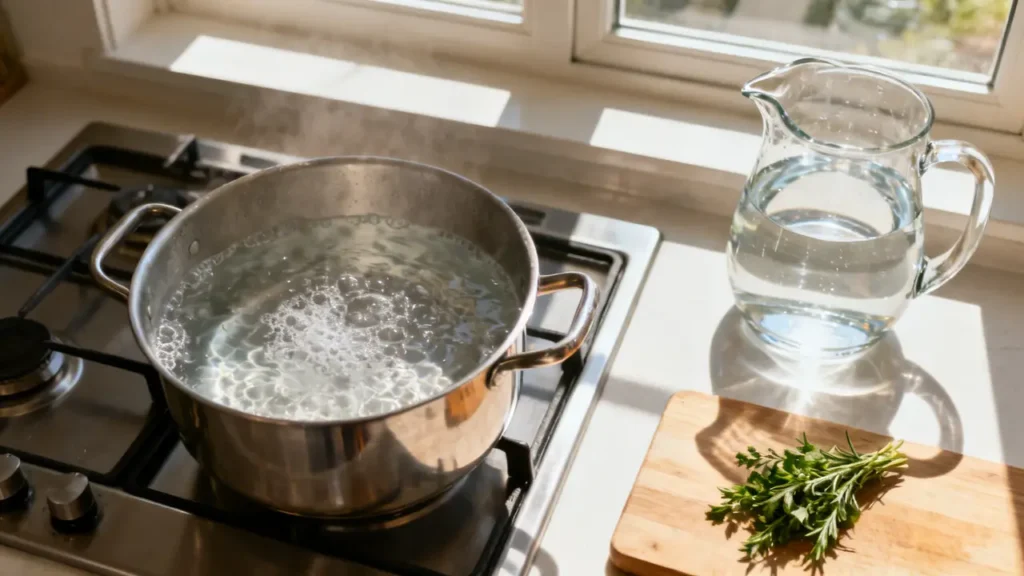
To remove free chlorine for taste and odor, bring water to a full rolling boil and keep it uncovered for about 15 minutes. Shorter boils of 5–10 minutes will remove most free chlorine, but 15 minutes is a conservative household recommendation. For microbiological safety follow CDC rules: boil 1 minute at sea level (and 3 minutes above 2,000 m / 6,562 ft). Boiling does not reliably remove chloramine; use catalytic carbon or a dechlorinator for that.
Why your tap water contains chlorine (and why it matters)
Municipal water systems add chlorine or chloramine to kill pathogens and keep water safe as it travels to your tap — that’s the public-health reason behind the smell or chemical taste many of us notice. Chlorine (free chlorine) typically appears as hypochlorous or hypochlorite in water and volatilizes (evaporates) relatively quickly; that’s why boiling or airing can remove it. Utilities sometimes use chloramine (a more stable compound of chlorine + ammonia) because it lasts longer in pipes and reduces byproduct formation, but that stability makes chloramine harder to remove by simple boiling or standing.
Why does this matter day-to-day? If you’re trying to kill microbes during a boil-water advisory, short boiling times meet microbial-safety targets. If your goal is to remove a chlorine flavor for drinking, cooking, brewing, or aquarium use, you need longer treatment or different methods depending on whether you have free chlorine or chloramine.
Free chlorine vs chloramine — why it changes your approach
Free chlorine and chloramine behave very differently — free chlorine volatilizes with heat or aeration, while chloramine is much more stable and resists boiling. That single fact determines whether boiling alone will solve your problem or whether you need filtration or chemical neutralizers. Treat your strategy like a simple fork in the road: free chlorine → boiling/aeration/carbon works well; chloramine → catalytic carbon or chemical dechlorinator.
How to tell what your water utility uses
The easiest way to know is to check your utility’s Consumer Confidence Report (CCR) or water-quality report online, or call the utility and ask whether they use chloramine or free chlorine. You can also use household chlorine test strips — many detect free chlorine but not chloramine specifically, so a low free-chlorine reading plus persistent taste/odor often points to chloramine. If in doubt, call your utility; they’ll tell you which disinfectant and typical concentrations they use.
How each responds to boiling, letting stand, filtration, and chemicals
Free chlorine is volatile: it comes off with heat, agitation, or time. Letting water sit uncovered for ~24 hours removes most free chlorine; aeration or stirring speeds this to a few hours. Activated carbon filters remove free chlorine quickly; some carbons rated for chloramine (catalytic carbon) also remove chloramine. Chemical neutralizers (e.g., sodium metabisulfite/Campden for brewing or aquarium dechlorinators) break down both chlorine and chloramine but follow product instructions carefully.
Boiling to remove chlorine — step‑by‑step protocol
If your utility uses free chlorine and your goal is removing the taste/odor, this is our practical protocol: pour tap water into a stainless or enamel pot, bring to a full rolling boil, and keep it uncovered for about 15 minutes. Leave it uncovered while boiling so chlorine can escape as gas, then cool and store.
Why 15 minutes? Shorter boils (5–10 minutes) will remove a lot of free chlorine, but we recommend 15 minutes as a reliable household middle ground that compensates for variable starting chlorine levels and container sizes. If your only goal is microbiological safety during an advisory, follow the CDC: boil 1 minute at sea level (and 3 minutes if you’re above 2,000 m / 6,562 ft), because that’s the time needed to inactivate pathogens rather than remove chemical disinfectants.
Practical tips while boiling
Use an open pot or kettle and do not seal the container; chlorine must be free to escape. Stainless steel kettles or an uncovered saucepan work best because they heat evenly, and you avoid concentrating flavors by not reducing the volume drastically. Avoid boiling in sealed jars or pressure cookers for chlorine removal — that traps gases and defeats the purpose.
How to cool, aerate, and store boiled water
Once boiled, let water cool uncovered until steam subsides to allow final off-gassing, then cover and refrigerate if storing. Covering once cool prevents dust and microbes from getting in and also stops the water from reabsorbing airborne compounds; a sealed glass or BPA-free plastic container is fine. If you’ll store more than 24 hours, keep water chilled and use within a few days for best taste.
If you want to verify your approach, inexpensive chlorine test strips let you check before and after treatment — a good step if you’re unsure whether your utility uses chloramine or free chlorine. For more on boil advisories and disinfection, see our guide to boil water advisory & disinfection guide.
Alternatives to boiling (when boiling is not enough or practical)
Letting water stand and aeration, activated carbon filtration, and chemical neutralizers are all valid alternatives that often beat long boiling in convenience or effectiveness — especially for chloramine. Activated carbon (look for filters certified for chloramine or labeled “catalytic carbon”) removes taste and both disinfectants in many systems; for aquariums and brewing, purpose-made dechlorinators are the usual recommendation.
Letting water sit uncovered for about 24 hours removes most free chlorine; stirring, splashing, or using a small aerator reduces that to a few hours. If you need a quick household fix for chloramine, use an appropriate filter cartridge or follow product instructions for a chemical neutralizer — and for brewing, many homebrewers use Campden tablets (sodium metabisulfite) to neutralize chlorine/chloramine, following dosage guidance.
- Quick decision guide: Drinking/safety only → boil 1 minute (CDC). Taste removal/free chlorine → boil uncovered 15 minutes or use carbon filter. Aquariums/brewing with chloramine → use dechlorinator or catalytic carbon.
How long to boil — evidence, common recommendations, and how we chose our times
Authorities like the CDC give short boiling times for microbial safety: 1 minute at sea level, and 3 minutes above 2,000 m / 6,562 ft, which is about killing pathogens, not removing chlorine. Home sources and hobby sites commonly suggest 5–20 minutes for chlorine taste removal; the range comes from variable starting chlorine concentrations and container surface area.
We recommend 15 minutes uncovered as a conservative, practical household target for removing free chlorine taste/odor because it balances energy/time cost with reliable off-gassing in typical kitchen pots. If you want faster results and you have a carbon filter rated for chlorine, that will often be quicker and use less energy.
Specific use cases & recommended approach
Different uses have different tolerances: for drinking during a boil advisory, use CDC times; for baby formula, follow pediatric guidance and cool boiled water properly; for aquariums, never rely on boiling if your utility uses chloramine — use an aquarium dechlorinator. For brewing, treat water specifically to avoid off-flavors and to control mineral content; many brewers prefer filtration plus a Campden tablet to neutralize both chlorine and chloramine.
For cooking, usual recipe boiling is fine — brief boiling will remove free chlorine from the water used in soups or pasta without much fuss. If you’re prepping water for infants or sensitive uses, we suggest pairing a short boil for microbial safety with a carbon filter or dechlorinator for taste/chemical removal.
Aquariums and fish tanks (short personal note)
I learned the hard way that boiling tap water for the fish tank didn’t protect my tetras when our utility switched to chloramine; they needed a proper dechlorinator. For aquariums, use a product labeled to remove chloramine, because chloramine’s byproduct ammonia is what actually hurts fish.
How to test whether chlorine is gone
The simplest household tool is a chlorine test strip: dip, wait the timed seconds, and compare colors to the chart to see free-chlorine levels. If test strips show near-zero free chlorine but you still detect a chemical smell, you may have chloramine present — for that you’ll need a chloramine-specific test or to check your utility’s report.
For the most reliable confirmation, use a test kit that measures both free chlorine and total chlorine, or contact a local water lab for a more detailed analysis. Testing helps you pick the right method — if strips show chloramine, skip long boils and use catalytic carbon or a dechlorinator instead.
Sources and further reading
For microbial-safety boil times see the CDC’s boil water guidance (1 minute at sea level, 3 minutes at elevation). For disinfectant chemistry and municipal practices see EPA resources on chlorination and chloramine. For hobbyist guidance on aquariums and brewing, consult aquarium-care or brewing-specific sources when choosing dechlorinators or Campden tablets.
If you want practical, related how-tos on our site, see our posts on how to boil water to get rid of chlorine and tips for how to boil water when camping for off-grid situations.


