
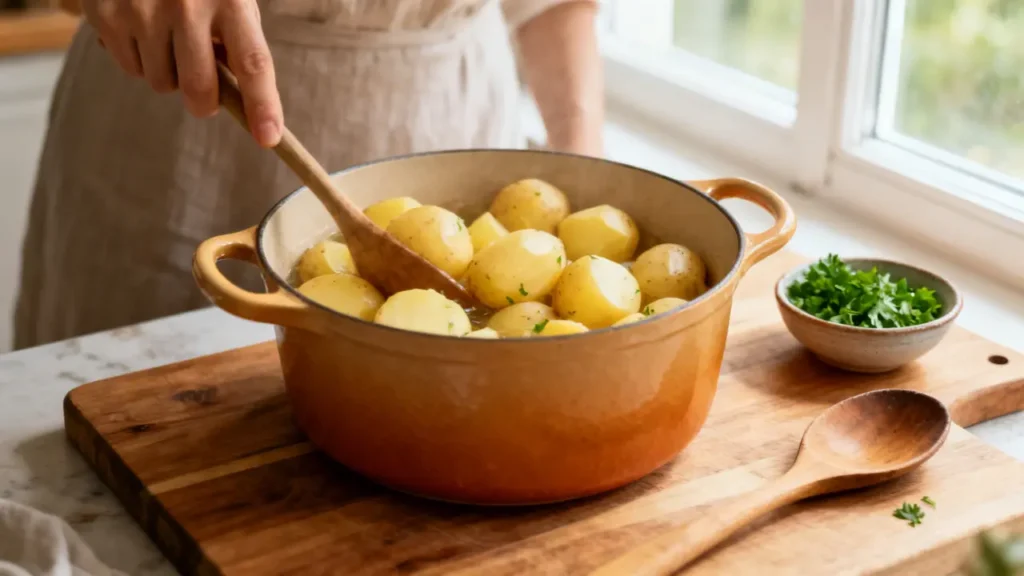

Quick answer — pick the method by your goal
If you need a short answer for how to reheat boiled potatoes: **use the microwave for speed (soft hot potatoes), the air fryer or oven for crisp skins, and the skillet or steam for gentle, even reheating**. Reheat to an internal temperature of 165°F / 74°C for safety (USDA).
We tested quick single-portion reheats and family-size trays; power, size, and how the potatoes were stored change the time. Choose the method based on whether you want fast and tender, or crisp and browned — we’ll show exact temps, times, and visual cues so you don’t guess.
Best method (short): For everyday reheating, the **air fryer or 375°F (190°C) oven** balances speed and texture; for the fastest heat, microwave covered for 30–90 seconds per potato.
Safety first — storage and target reheating temperature
Food safety matters: cooked potatoes should be cooled and refrigerated within **2 hours** and kept for **3–4 days** in the fridge; frozen boiled potatoes keep quality up to **3 months**. If you’re reheating, the USDA recommends bringing leftovers to an internal temperature of **165°F / 74°C** — that’s the number to check with an instant-read thermometer.
Cool potatoes quickly by spreading them in a shallow container or tray so they drop below 40°F faster, and store in airtight containers to reduce moisture loss. For freezing, flash-cool then freeze in single-layer trays before transferring to bags to avoid large frozen clumps.
How long boiled potatoes last (fridge vs freezer)
Store cooked potatoes in the refrigerator for **3–4 days**; don’t keep them longer because bacterial growth increases. In the freezer, tightly wrapped or in freezer bags, they’ll be fine for **up to 3 months** for best quality — texture may change after that.
Tip: label containers with date and portion size. If you plan to reheat often, freeze in single portions so you can warm just what you need and avoid repeated reheating.
Reheat temperature (and why)
The food-safety target when reheating leftovers is **165°F (74°C)** because that temperature reliably reduces pathogens in previously cooked food. Use an instant-read thermometer inserted into the center of the potato to confirm; visual heat alone (steam rising) isn’t enough for safety when leftovers have been stored.
We keep a cheap instant-read on the counter — it’s one of the simplest tools that saves a lot of guesswork. If you’re reheating in a skillet or oven, check a couple of potatoes in the middle of the batch for evenness.
Reheating methods — step-by-step (best-for and time/temps)
Below are methods we use regularly, each with the ideal goal, temperature, and typical times. For each method we list the best-for scenario — whole large potatoes, halved, sliced, or baby potatoes — and give visual cues so you know when they’re done.
Oven — best for whole potatoes and crisp skins
Preheat the oven to **375°F (190°C)**. Arrange halved or whole potatoes on a rimmed sheet, brush with a little olive oil or melted butter, and bake **10–20 minutes for halves, 15–25 minutes for whole large potatoes**, flipping once. The surface should look dry and slightly browned and an instant-read thermometer should read **165°F / 74°C** at the center.
If you want extra crisp, raise the oven to **400°F (205°C)** for small pieces and reduce time slightly (watch for over-browning). For large batches, space the potatoes so hot air can circulate — crowding gives you steaming instead of crisping.
Air fryer — fastest crisp for small/medium potatoes
Preheat the air fryer to **375°F (190°C)** and place a single layer of potatoes in the basket. Cook **6–12 minutes**, shaking or flipping halfway through; small baby potatoes need nearer 6–8 minutes, larger halves closer to 10–12 minutes. Look for a golden, crisp exterior and **165°F / 74°C** inside.
The air fryer is our go-to when we want crispy edges without heating the whole oven. For very large quantities, you’ll need to work in batches to keep crisp results.
Stovetop skillet — quick crisp and best flavor
Slice or halve potatoes, heat a skillet over medium with **1–2 tbsp oil or butter**, add potatoes cut-side down and cook **5–8 minutes** to brown, then cover for **2–3 minutes** to finish heating through. Uncover and let them crisp again for a minute. Look for crunchy edges and **steam/temperatures** that indicate the middle reached **165°F / 74°C**.
If potatoes are dry, add a splash of stock or water when covered to rehydrate. Daniel swears by finishing with a pat of butter and flaky salt right at the end.
Microwave — fastest for soft, hot potatoes
Place potato pieces or a single potato on a microwave-safe plate, cover with a damp paper towel or vented lid, and microwave on high. **30–90 seconds per small/medium potato**, or **1–3 minutes** for multiple pieces, stirring or flipping halfway. Check that the center reaches **165°F / 74°C**.
Microwave can make starchy potatoes gluey if overheated; heat in short bursts and test. Add a little butter, cream, or broth after microwaving to refresh texture for mashed or smashed versions.
Steam or simmer — gentle reheating without crisping
For soft, evenly heated potatoes, steam in a basket over boiling water for **5–8 minutes**, or simmer in a shallow pan with **1/4 cup stock or water** covered until hot. This method rehydrates potatoes and avoids the dry, crumbly outcome that high heat can cause.
Use this if you plan to mash or serve with a sauce — it preserves a moist interior and keeps the flavor intact.
Sous vide — best for perfect texture (advanced)
Sous vide gives the most controlled reheating: vacuum or bag leftover potatoes and warm at **135–140°F (57–60°C)** for **20–40 minutes** to bring them through gently. If you must meet USDA guidance, finish until the bag’s contents reach **165°F (74°C)**, though that can change the texture.
Pros are even heating and no drying; cons are time and equipment. This is our pick when texture precision matters for a dinner party.
Reheating frozen boiled potatoes
For best results, thaw overnight in the fridge. If reheating from frozen, use the oven or air fryer at the listed temperatures and add **about 5–10 minutes** to the time listed above; microwave from frozen in short bursts, checking texture. Always confirm an internal **165°F / 74°C** before serving.
Thawing first prevents the outside from overcooking while the center is still cold, so plan ahead when you can.
Which method to choose — by potato type and serving
New/baby potatoes: air fryer or skillet at **375°F / medium heat** for best crispness. Medium red/white potatoes: oven or skillet works well. Large russets: oven at **375°F (190°C)** to reheat through without collapsing. Smashed potatoes benefit from skillet crisping after steaming; potato salad should generally not be reheated (see storage notes).
For mashed leftovers, reheating gently with added milk or cream and stirring frequently prevents gumminess — the microwave or stovetop low heat with stirring works best. If you want a fuller dive into reheating mashed potatoes, try our related post on reheating mashed potatoes for detailed steps.
Related: if you want storage pointers, check How to store boiled potatoes, and for oven-specific finishes see Baking boiled potatoes. If you prepared the potatoes in a pressure cooker, our Instant Pot potatoes guide also helps plan reheating.
Troubleshooting — fix common problems
Soggy potatoes? Move them to a hot skillet or air fryer at **375°F (190°C)** to crisp the exterior. Dry or crumbly potatoes need a little fat or liquid and a gentle steam — add **1–2 tbsp butter** or a splash of stock and cover for a few minutes. Gummy or gluey texture (especially with mashed) means starch was overcooked; reheat gently and stir in cream or butter off heat.
Uneven heating often comes from crowding or reheating straight from frozen — cut into smaller pieces or lower the temperature and add time for more even results. Use an instant-read thermometer to confirm uniform heat.
Flavor & finishing tips
Finish reheated potatoes with a drizzle of olive oil or a pat of butter, a sprinkle of flaky salt, and fresh herbs like parsley or chives just before serving. For extra flavor, toss pan-reheated potatoes with minced garlic and a squeeze of lemon, or finish in a hot oven for one to two minutes to set a crisp crust.
If you’re reheating for a crowd, add seasoning after reheating rather than before — salts and acids concentrate during storage and can change the balance. Pro tip: add coarse salt after crisping to preserve crunch.
Tools, timing chart & visual cues
Keep an instant-read thermometer, an oven/air fryer thermometer, and a rimmed sheet or skillet handy. Visual cues help: **steam and a moist surface** = likely hot but not crisp; **golden-brown edges** = crisp and done; **soggy skin** = needs higher heat or less crowding. Use the chart below as a quick reference.
- Small/baby (whole): Air fryer 375°F, 6–10 min; Oven 375°F, 10–15 min
- Medium (halved): Oven 375°F, 10–20 min; Skillet medium, 5–8 min
- Large (whole): Oven 375°F, 15–25 min; Microwave 2–3 min then finish in oven/skillet
- Frozen: Add ~5–10 min to oven/air fryer times; microwave longer in bursts
Visual cue: when the center registers **165°F / 74°C** and the outside looks the way you want, they’re done. If you cook for appearance only, you might miss cold centers — always spot-check with a thermometer for safety.
Summary — our recommended go-to methods
For most home cooks: the **air fryer at 375°F (190°C)** for crispy bites and the **microwave covered for 30–90 seconds** for single hot servings are the fastest wins. For perfect large potatoes or trays, the **oven at 375°F (190°C)** is steady and reliable. Always confirm **165°F / 74°C** internally for safety.
If you want more on storage and batch prep, read how to store boiled potatoes and our notes on freezing to make reheating simpler. Sarah learned the hard way that tossing hot boiled potatoes into the fridge in a deep pot traps heat and makes them sit too long at unsafe temperatures — shallow containers are the fix.


