
Hash Brown Crusted Quiche
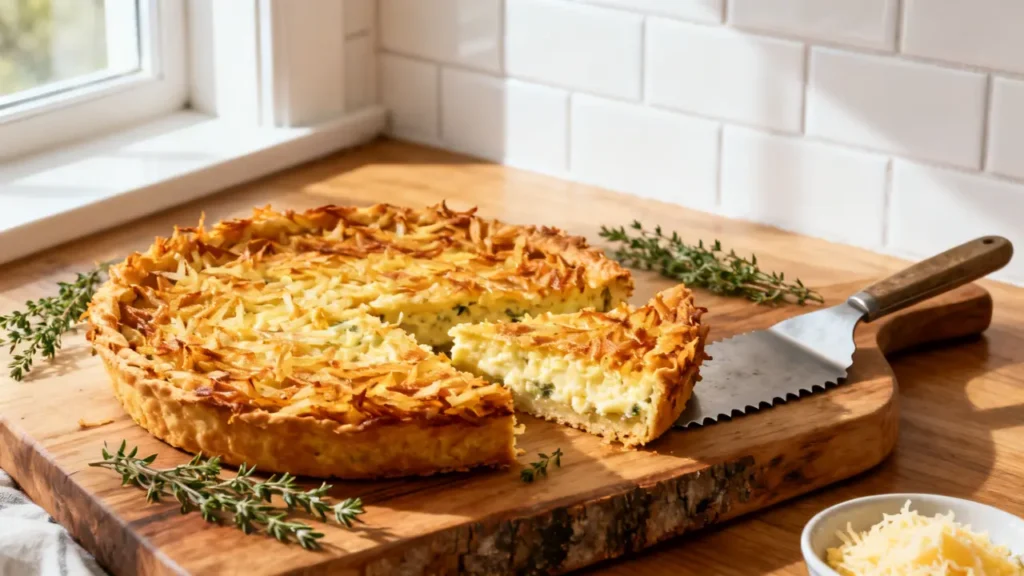
This hash brown crusted quiche replaces pastry with a shredded potato shell for a crunchy, gluten‑free base that holds a classic egg custard. It serves 6–8, needs about 15 minutes active prep and 35–45 minutes baking depending on your pan, and rests 15–20 minutes before slicing. Follow our method to avoid the most common pitfall: a soggy crust.
We leaned into simple technique and one clear goal: crisp, non‑soggy potato crust. That means controlling moisture, adding fat for browning, and often par‑baking or searing the crust before it meets the custard. Read through the full method and the troubleshooting section — those little steps are what make the difference.
Why a hash brown crust works (and pitfalls to avoid)
A hash brown crust works because shredded potato with a bit of fat browns and crisps, forming a sturdy shell that’s naturally gluten‑free and very flavor‑forward. The main pitfall is moisture: potatoes, especially frozen ones, hold water that turns to steam under custard and makes the crust soggy if you don’t dry and pre‑crisp it.
To outsmart that moisture you need three things: dry potatoes (thaw and squeeze or use par‑boiled fresh spuds), fat to promote browning (butter or oil), and heat to set and seal the crust before the custard goes in. We recommend par‑baking at 400°F (205°C) or skillet‑searing first, then baking the quiche at 375°F (190°C) for the main cook.
Ingredients (for a 9-inch quiche)
Here’s a reliable ingredient set for a standard 9″ pie plate: 2–3 cups shredded hash browns (about 10–12 oz frozen) for the crust, 6 large eggs and 1½ cups dairy for the custard, plus cheese and fillings. Use the swaps below to tune texture: cream for richness, milk for firmer set.
Notes on key items: toss thawed hash browns with 1–2 tbsp melted butter per cup and optionally stir in 1 beaten egg to bind the crust. For custard, our tested ratio is 6 eggs + 1½ cups dairy (half‑and‑half or 1 cup heavy cream + ½ cup milk). Use fully cooked, well‑drained fillings (bacon, ham, sautéed veggies) to avoid extra liquid.
- Hash browns: 2–3 cups (10–12 oz shredded frozen or equivalent fresh)
- Eggs: 6 large
- Dairy: 1½ cups (half‑and‑half or cream/milk combo)
- Cheese: 1–1½ cups grated (cheddar, gruyère, Swiss)
- Butter/oil: 1–3 tbsp total for crust + pan
- Salt & pepper: ¾–1 tsp salt (season custard and crust lightly)
Equipment & pan choices
Use a 9‑inch pie plate for a classic depth and cook time; a 10‑inch skillet yields a thinner quiche and bakes faster, while a muffin tin makes mini quiches (see troubleshooting for scaling). An ovenproof skillet gives you the option to sear the crust on the stove first for extra crispness.
Other helpful tools: an instant‑read thermometer (aim for 165°F / 74°C internal), a clean towel or cheesecloth for squeezing potatoes, and a fork or offset spatula to press the crust evenly. If you have convection, reduce oven temp by ~25°F (15°C).
Step-by-step method
Step 1 — Prep the hash brown crust
Thaw frozen hash browns fully and squeeze out as much moisture as possible using a towel or cheesecloth — this is the single most important step. If you’re using fresh potatoes, shred, blanch for 1–2 minutes, cool, then squeeze dry; fresh spuds often need an extra squeeze to match frozen’s texture.
Toss the dried shreds with 1–2 tbsp melted butter per cup and ¼–1 beaten egg (optional) to help the crust bind. Press evenly into your 9″ pan to a thickness of about ¼–½ inch at the base and slightly thicker around the rim so it holds the custard.
Step 2 — Crisping the crust (two reliable methods)
Option A: Par‑bake the pressed crust at 400°F (205°C) for 12–15 minutes until the edges look set and the surface is beginning to brown. No weights needed; you want the potatoes to lose steam and start to brown so they repel custard moisture.
Option B: Skillet sear. Heat 1 tbsp butter or oil in an ovenproof 10″ skillet, press the crust in and sear on the stovetop for 4–6 minutes until the bottom is deeply golden, then transfer to a 400°F (205°C) oven for 6–8 minutes to finish crisping before adding fillings.
Step 3 — Prepare the fillings
Cook meats until crisp (bacon or pancetta), sauté vegetables until most of their moisture has evaporated, and drain anything wet. Add fillings sparingly — aim for about 1–1½ cups total so the custard can surround and bind them without overloading the crust.
Step 4 — Make the custard
Whisk 6 large eggs with 1½ cups dairy (half‑and‑half or 1 cup heavy cream + ½ cup milk) and season with ¾ tsp salt and fresh pepper. The 6 + 1½ ratio gives a custardy but set texture; for firmer quiche use less dairy, for silkier quiche use slightly more cream.
Step 5 — Assemble and bake
Layer a light sprinkle of cheese, add your fillings, then pour the custard evenly into the pre‑crisped crust. Lower oven to 375°F (190°C) and bake for 35–45 minutes for a 9″ quiche; deeper skillets may need 40–55 minutes or bake at 350°F (175°C) for a gentler finish.
Test doneness with a thermometer — the center should reach 165°F (74°C) for safety and a creamy set. The surface may still have a slight jiggle; that’s normal. If the crust edges brown too quickly, tent loosely with foil after 20–25 minutes.
Step 6 — Rest and serve
Let the quiche rest for 15–20 minutes before slicing; the custard finishes setting and slices cleanly. Serve warm or at room temperature — it holds well and travels nicely for brunches.
Printable recipe card
- Yield: 6–8 slices
- Prep: 15 minutes
- Cook: 35–45 minutes
- Internal temp target: 165°F / 74°C
- Ingredients: 2–3 cups shredded hash browns, 1–2 tbsp melted butter per cup, 1 beaten egg (optional for crust), 6 large eggs, 1½ cups dairy, 1–1½ cups grated cheese, fillings (1–1½ cups), salt & pepper.
- Thaw and squeeze hash browns very dry. Toss with butter and optional egg. Press into 9″ pie plate.
- Par‑bake at 400°F (205°C) for 12–15 minutes or skillet‑sear 4–6 minutes then finish in oven.
- Cook and drain fillings; layer cheese and fillings in crust.
- Whisk 6 eggs + 1½ cups dairy, season, pour in. Bake at 375°F (190°C) for 35–45 minutes until center is 165°F (74°C).
- Rest 15–20 minutes before slicing.
Troubleshooting: common problems fixed
Soggy crust? The usual suspects are not squeezing the potatoes enough, adding wet fillings, or not crisping the crust before the custard. Fixes: squeeze harder, par‑bake or sear, and add a binder (1 beaten egg) to the crust if shredding doesn’t stick together.
Runny center? Either the custard needs more time or your thermometer target was missed. Put the quiche back in for 5–10 minute increments until it reaches 165°F (74°C). To avoid overbrowning the top, tent with foil while you finish.
Overbrowned edges? Cover the rim with a strip of foil after about 20–25 minutes in the oven. For convection ovens reduce temp by 25°F (15°C) and check early — convection browns faster.
Mini quiches in muffin tins: scale to 9 eggs + 2 cups dairy for 12 muffins and use 3–4 cups hash browns; bake at 350°F (175°C) for 20–25 minutes.
Personal note: I used to press thawed hash browns straight into the pan and wonder why the bottom stayed limp. I learned the hard way that thoroughly squeezing and a quick sear make the night‑and‑day difference — now Daniel teases me that I measure towels by their potato‑wringing power.
Variations & flavour ideas
Classic combos that work well with the potato crust include Quiche Lorraine (bacon + gruyère), Spinach & Feta, Mushroom & Swiss, and Ham & Cheddar. Use about 1–1½ cups filling so the custard still surrounds the mix — too much filling dilutes the set and increases bake time.
If you want a lighter version, swap half the cream for milk and cut cheese to ¾ cup. For a richer, restaurant‑style quiche use 1 cup cream + ½ cup milk and extra cheese; expect a slightly longer bake to reach 165°F (74°C).
Want to make hash browns from scratch first? See our guide on how to boil potatoes for hash browns for tips on achieving the right starch and moisture before shredding. For how this quiche stacks up to a classic custard quiche, check our hash brown crusted quiche recipe variations and tips.
Make-ahead, freezing & storage
You can refrigerate a finished quiche for 3–4 days (wrapped) and freeze for up to 2 months tightly wrapped. To freeze best: cool completely, slice if desired, flash‑freeze on a tray, then wrap slices or whole quiche in foil and a freezer bag.
Reheat slices from the fridge at 350°F (175°C) for 10–15 minutes until warmed through; from frozen, reheat at 350°F for 25–35 minutes (cover loosely with foil for the first 20 minutes). Avoid microwaving if you want to preserve crispness — the oven brings the crust back to life.
Nutrition estimate (per slice, 1/8)
A rough estimate per slice: about 320–420 calories depending on dairy and cheese choices, with ~20–28 g fat (less if you use milk), ~12–18 g protein, and ~12–20 g carbs. Allergen note: contains eggs and dairy; swap dairy for a plant alternative for a different nutrition profile though texture will change.