
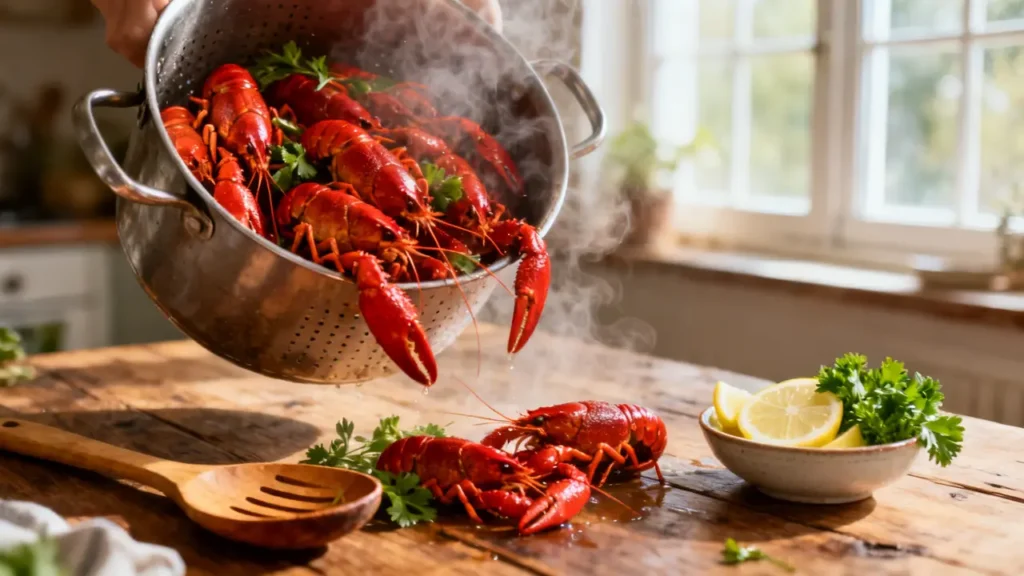

What “soak” (or “steep”) means after a crawfish boil
After the boil, “soak” or “steep” means leaving the cooked crawfish in the hot seasoned cooking liquid so seasoning and heat continue to move into the meat; it’s a flavor‑boosting rest more than another full cook. Think of it as a short infusion: seasoning diffuses while residual heat carries flavor into the tails.
This post explains the difference between that post‑boil steep and the pre‑boil purge/soak used on live crawfish. If you want the pre‑boil technique, check our guide How to Purge (Soak) Live Crawfish Before Boiling for the right method. The post‑boil soak is about minutes and temperature control, not hours.
how long to let crawfish soak after boiling — recommended soak times
The short answer: 10–20 minutes is the sweet spot for most home crawfish boils; extend to 20–45 minutes only for very large insulated batches. Avoid letting crawfish sit in hot liquid more than 60 minutes if you care about firm texture — longer steeping makes the meat soft and mushy.
Choose 5–10 minutes for quick service or if you like a milder seasoning; use 10–20 minutes as the default when cooking for friends and family. For big parties where you transfer the cooked crawfish to an insulated cooler, 20–45 minutes will deepen flavor but watch texture and temperature.
- 5–10 minutes — light flavor, immediate service, small pot
- 10–20 minutes — standard home-cook recommendation
- 20–45 minutes — large insulated cooler batches for deeper flavor
- Avoid > 60 minutes in hot liquid to prevent mushy meat
Why soak works — the science in plain English
Soaking works because of diffusion and residual heat. The hot seasoned broth (typically near boiling right after cooking) contains salt, spices, and aromatics; while the crawfish cool slightly, those solutes move slowly into the meat and make it taste more seasoned. Heat also continues to denature proteins, so the meat firms then relaxes — too much time and it becomes overdone.
In plain terms: flavor absorption is time + temperature, and texture is heat exposure. That’s why we recommend tying your soak time to how hot the liquid stays and how many crawfish are packed into the pot or cooler.
Temperature & food-safety rules you must follow
Food safety matters: keep cooked crawfish and other perishable boil items at or above 140°F (60°C) while hot-holding. If the pot or cooler drops below 140°F and the food enters the temperature danger zone (40–140°F / 4–60°C), apply the 2‑hour rule (1 hour if ambient is >90°F/32°C) before discarding.
Use an instant‑read thermometer to check the broth or cooler. For leftovers, cool to below 40°F within two hours and eat refrigerated crawfish within 48 hours, reheating to 165°F (74°C) before serving. For last‑minute reheats, dunking tails in boiling water (212°F / 100°C) for 30–60 seconds works well without wildly overcooking the meat.
How to soak properly — step-by-step method for perfect flavor and texture
Do the soak immediately after you pull crawfish from the boil and turn the burner down or move the pot to a safe, warm area. Start the clock when the crawfish are back in the seasoned liquid and the lid is on (or the cooler is closed) so you measure the actual steep time.
For home cooks / small pots
Answer: for small home pots keep the pot covered and let crawfish steep for 10–20 minutes. That timing gives the tails good seasoning penetration without turning them mushy in most cases.
- Turn the heat off but leave the pot on the burner; place the lid on to trap heat.
- Start a timer for your target (10–20 minutes).
- Stir once after 5–10 minutes to redistribute seasoning if the pot is crowded.
- When time’s up, serve immediately or transfer to an insulated container that stays above 140°F.
For large boils / parties (using a cooler)
Answer: transfer crawfish and broth to an insulated cooler and aim for 20–45 minutes in a cooler that holds heat well; check temps. Use towels/blankets for extra insulation if your cooler leaks heat quickly, and stir once if you’ll be holding on the long side of that window.
- Drain just enough water so crawfish aren’t swimming in an inch of liquid, then pour in the seasoned broth and close the cooler.
- Wrap the cooler in blankets or towels for extra insulation and monitor temperature with a probe.
- Stir after 15–20 minutes to keep seasoning even and pull a few for testing — don’t let the cooler sit unchecked past 45–60 minutes.
If you’re building a full party plan, our step-by-step Cajun boil recipe walks through timing and seasoning ratios: Cajun Crawfish Boil Recipe (step-by-step).
Vegetables & extras (potatoes, corn, sausage)
Answer: starches and veg continue to absorb seasoning during the soak and can get mushy if left too long. Time potatoes and corn to finish slightly before the crawfish if you like a firmer bite, or pull them earlier and add back into the cooler for the flavor soak only.
For coordinated sides, see our guide on timing potatoes, corn, and sausage: Best Sides for a Crawfish Boil (potatoes, corn, sausage timing).
How to tell when the crawfish are ready from a texture/taste perspective
Answer: the tails should be firm but tender, not stringy or falling apart, and the flavor should taste infused on a small tail‑taste test after about 10 minutes. If the meat flakes and feels mushy, it’s over‑steeped; if it’s bland, it needs a brief reheat in seasoned broth.
Do a quick taste test: peel one tail after your minimum soak time and check seasoning and texture. If under-seasoned, a short 1–2 minute reheat in fresh seasoned broth or a drizzle of garlic‑butter will fix it without re-cooking tails for long.
Common problems & troubleshooting
Answer: common issues are under‑seasoned tails, over‑steeped (mushy) meat, and food‑safety/temperature mistakes. Each has a fast, practical fix: a quick reheat for under-seasoned, repurposing overly soft tails, and strict temp control for safety.
If crawfish are under‑seasoned, reheat them for 1–2 minutes in boiling broth or toss in warmed garlic butter and lemon. If they’re over‑steeped and limp, we use them in gumbo or étouffée where texture is less critical. If they’ve cooled into the danger zone, discard per the two‑hour rule — don’t risk it.
How to store leftover crawfish (and how long they last)
Answer: refrigerate cooked crawfish within 2 hours (1 hour if >90°F ambient) and eat within 48 hours; freeze for up to 3 months for best quality. Cool quickly by removing crawfish from hot liquid and spreading in a shallow pan before refrigerating.
To reheat safely, warm to 165°F (74°C). Our storage and reheating guide has step‑by‑step tips for chilling and thawing without ruining texture: How to Store and Reheat Cooked Crawfish Safely. A short dunk in boiling water (30–60 seconds) is the fastest way to reheat a portion without overcooking.
Visual quick-reference: soak time chart and thermometer guide
Answer: match method to time—small pot 10–20 min, insulated cooler 20–45 min, never over 60 min in hot liquid; keep broth ≥ 140°F (60°C). Use an instant‑read or probe thermometer to confirm the holding temp and aim to check every 15–20 minutes during long holds.
- Small pot: 10–20 minutes, lid on, stir once
- Insulated cooler: 20–45 minutes, monitor temp, stir at 15–20 minutes
- Short fix: dunk 30–60s in boiling water to reheat
Conclusion — recommended default and final safety note
Answer: for most home cooks the right rule is 10–20 minutes of post‑boil soak in the hot seasoned liquid, keeping the pot or cooler above 140°F (60°C). For big insulated batches push to 20–45 minutes with careful temp checks, but don’t exceed an hour if you want firm tails.
We’ve linked helpful step‑by‑step resources above — from pre‑boil purging to full recipes — so you can plan a boil that’s flavorful and safe. If you want the full boil recipe and seasoning ratios, see our step‑by‑step Cajun Crawfish Boil Recipe (step-by-step).
Pro tip: I learned the hard way that stuffing a pot too full slows cooling but speeds overcooking — when in doubt, split into two pots or use a deep cooler and check the temperature early.


