
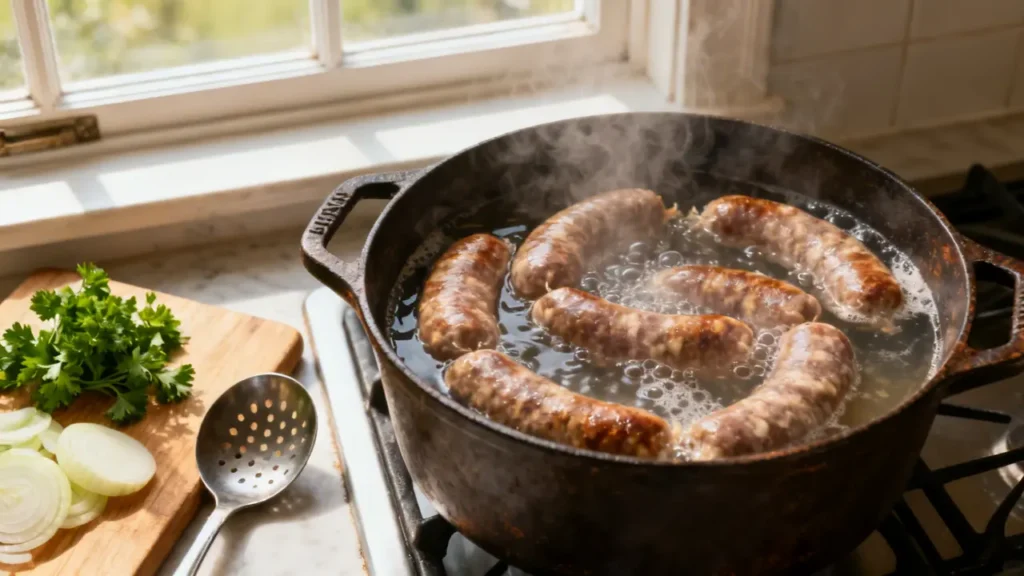

Want a quick answer on how long to boil boudin? Boil pre-cooked thawed links at a gentle simmer for 8-10 minutes, frozen for 15-20 minutes, and cook raw/homemade until the center reaches 160°F (71°C). Always check with an instant-read thermometer. Plus quick tips to avoid burst casings and dry filling.
Quick answer — Boiling times at a glance
If you’re asking how long to boil boudin, the short, practical answer depends on whether it’s pre-cooked, frozen, or raw. For store-bought or vendor boudin that’s already cooked and thawed, simmer gently for 8–10 minutes. From frozen, allow 15–20 minutes at a simmer, and for raw/homemade boudin cook until the internal temp hits 160°F (71°C) (usually about 12–18 minutes for typical links).
Time ranges are a starting point — the only reliable finish test is temperature, so use an instant-read thermometer every time. Reheating targets: when reheating a pre-cooked product bring it to 165°F (74°C) if the label or your local food-safety guidance asks for it. Do not boil vigorously; maintain a gentle simmer to protect the casing and texture.
- Pre-cooked / store-bought (thawed): 8–10 minutes simmer
- Pre-cooked (frozen): 15–20 minutes simmer
- Raw / homemade: simmer until 160°F (71°C) — roughly 12–18 minutes
- Thermometer tip: insert into the thickest part of the link, avoiding the casing edge for an accurate reading
Do you need to boil boudin? Raw vs pre-cooked explained
Not every boudin needs the same treatment because some are already fully cooked at the butcher or factory and only need reheating. Check the label or ask your vendor: refrigerated boudin from a store is often pre-cooked and safe to eat after reheating, while homemade recipes using raw pork must be cooked to 160°F (71°C) for safety. If in doubt, follow the temperature rule — it resolves conflicting directions.
Why this matters: ground pork is higher risk for bacteria, so USDA guidance requires cooking ground pork products to 160°F (71°C). For reheating pre-cooked sausage you should bring it to 165°F (74°C) if the package or your local guidance asks for it to ensure hot-holding safety. If you want the recipe for homemade boudin to compare, see our homemade boudin recipe for the raw-cook steps and times.
Step-by-step — How to boil boudin (best method)
Follow a gentle-simmer method: bring a large pot of water (or seasoned stock) to a simmer, lower the boudin in gently, maintain a steady simmer (not a rolling boil), and cook to the times or temps in the chart. This approach protects casings and keeps the filling from drying or turning rubbery. Always finish by checking the internal temperature with an instant-read thermometer.
Equipment & prep
You’ll want a large pot, tongs or a slotted spoon, an instant-read thermometer, and a plate to rest the links. Fill the pot so the links float mostly submerged without crowding — about 4–6 quarts for a dozen links depending on size. Do not routinely prick the casings: avoid puncturing to keep juices; only make small pricks if a link consistently bursts despite a gentle simmer.
Exact steps
- Fill a pot with enough water to cover the links and bring it to a gentle simmer (small bubbles, steam rising). Do not let it reach a hard rolling boil.
- Gently lower boudin into the simmer with tongs or a slotted spoon; reduce heat so the water stays at a steady simmer and partially cover the pot.
- Time according to the chart: 8–10 minutes (thawed, pre-cooked), 15–20 minutes (frozen pre-cooked), or simmer raw until internal temp is 160°F (71°C) (12–18+ minutes depending on diameter).
- Remove with a slotted spoon, let rest 1–2 minutes, then slice and serve. If you like a crisp casing, finish in a hot skillet for 1–2 minutes per side.
Small visual cues matter: the casing should look plump and firm but not taut and split; the filling will be hot and steaming at the cut. If you see bubbling tears along seams, your heat is too high or you’ve overcooked. Daniel swears by the thermometer and a quick skillet sear to get the best texture every time.
Boiling frozen boudin — safe method
You can safely boil boudin from frozen, but it needs extra time and patience — plan on 15–20 minutes at a gentle simmer for typical frozen pre-cooked links. Larger or very thick cased links may take longer; always verify with a thermometer. Never start frozen links in a rolling boil; bring water to a gentle simmer first and lower them in carefully.
If you prefer faster, safely thaw frozen boudin in a cold water bath (sealed bag in cold water) for 30–60 minutes depending on size, then simmer 8–10 minutes. Thawing evenly helps the casing and filling reheat without sogginess from trapped ice melting inside the casing.
If you have raw/homemade boudin — times and safety
Raw or homemade boudin must be cooked fully to 160°F (71°C) — time estimates are helpful, but temperature is the rule. Typical links 1–1.5 inches in diameter finish in about 12–18 minutes at a simmer, but thicker links often need more time. Use an instant-read thermometer inserted into the center of the filling for a reliable read.
Follow good handling: keep raw boudin chilled until just before cooking, and don’t reuse cooking water for other foods. If you like a crust, after boiling to temp, dry and quickly brown the links in a hot skillet or on the grill for 1–3 minutes per side.
Alternatives to boiling (quick pros, cons & times)
Boiling is gentle and even, but other reheating methods work great depending on texture you want — steaming keeps moisture, ovens are hands-off, and pan-searing crisps casings. Choose a method by whether the boudin is raw, pre-cooked, or frozen and by how much crispness you want. Here are quick times to keep handy.
- Steaming: Thawed 10–12 min; frozen 20+ min — gentle and maintains juiciness.
- Oven: 350°F (177°C) for 20–25 min (thawed), turning once — good for batches.
- Pan-fry / Grill: Medium heat 6–8 min (thawed), turning frequently — best for crisp casing.
- Air fryer: 375°F (190°C) for 6–10 min (thawed) — quick and crisp.
- Microwave: Fast but uneven; use short bursts and finish in a pan to crisp — ~1–2 minutes depending on power.
Troubleshooting — common problems & fixes
Most problems come down to heat control and timing: a rolling boil bursts casings, overcooking yields dry or rubbery filling, and uneven reheating leaves a cool center. The fixes are simple: lower heat to a steady simmer, use a thermometer, and finish in a hot skillet for texture rather than extended boiling. Keep a close eye on frozen/thawed transitions so water temperature stays consistent.
- Burst casing: Cause — water too hot or trapped steam. Fix — simmer, don’t boil; if it bursts, drain and finish the filling in a skillet or bake 5–8 minutes.
- Rubbery filling: Cause — overcooking or high heat. Fix — shorter simmer next time and finish with a quick sear instead of longer boiling.
- Cold center: Cause — uneven reheating. Fix — return to simmering water for a few minutes or oven at 350°F until internal temp reaches 165°F (74°C) for reheated items.
I once brought a pot to a furious rolling boil and learned the hard way that several links split — lesson learned: patience and a thermometer beat guessing every time. Since then I always start with a gentle simmer and rest the links briefly before slicing; it keeps the filling juicier and the casing intact.
Flavor tips — how to boost taste while boiling
Boiling in plain water is fine, but a little flavor boost goes a long way: use low-sodium chicken stock or add onion halves, smashed garlic, bay leaves, and a few peppercorns to the simmering liquid. The boudin won’t soak up heavy seasoning, but the subtle lift is noticeable, especially when you finish with a quick skillet sear. Serve with mustard, pepper vinegar, or classic Creole sides like dirty rice and pickled veg for contrast.
Quick printable checklist & time chart
Takeaway checklist: large pot, thermometer, gentle simmer, don’t crowd the pot, and rest 1–2 minutes before slicing. Use the time chart above as your fast reference and always verify doneness by temperature rather than minutes alone. For more on reheating different sausages see our reheat sausages guide and for the official temperature references check the USDA meat temperature guide.


