
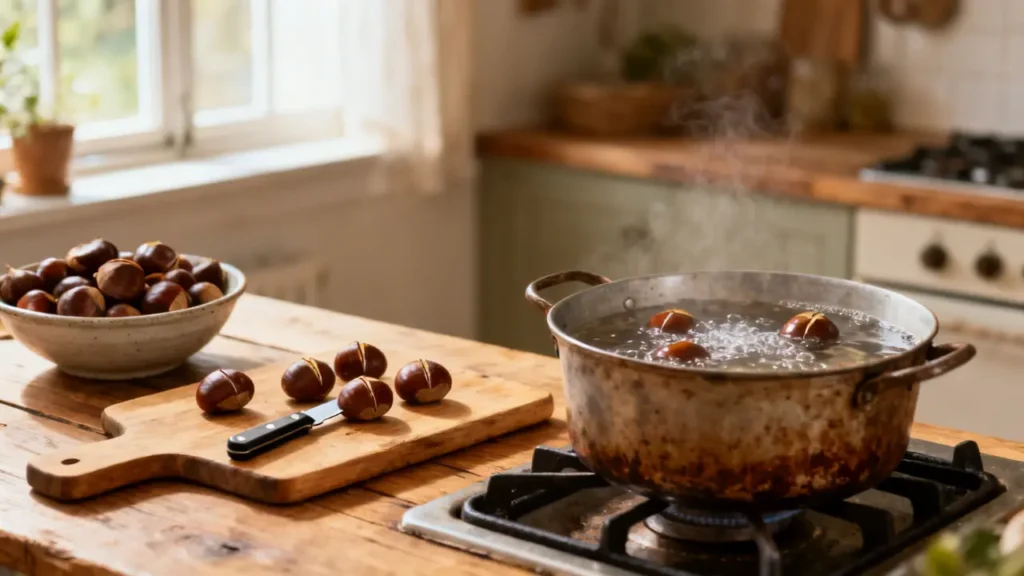

Boil scored chestnuts for 10-15 minutes before roasting to loosen the shell and pellicle and to gently tenderize the nut. For very large or older nuts, check at 18-20 minutes; drain, dry, then roast at 400-425°F (200-220°C) to finish and develop flavor. Peel while still warm for easiest removal and a glossy, sweet nut.
Quick answer
The short answer to “how long to boil chestnuts before roasting” is 10-15 minutes for average fresh chestnuts. Look for the shell to split at the score and the flesh to be fork-tender but not falling apart, then roast to get the classic roasted color and flavor.
Why boil chestnuts before roasting?
Boiling loosens both the hard outer shell and the papery inner skin called the pellicle, and it gives the meat a head start on softening so it finishes evenly in the oven. This saves roasting time and makes peeling far easier, especially if the nuts are not ultra-fresh.
Scientifically, the brief simmer softens cell walls without waterlogging the starches. Overcooking in water dissolves sugars and dilutes the roasted flavor, which is why we recommend a controlled 10-15 minute simmer for most nuts.
When to boil and when to skip
Best for fresh, medium and large chestnuts
Boil first if the chestnuts are medium to large, a bit older, or you want the easiest peeling. Those conditions benefit most from a short parboil to loosen skins and prevent an undercooked center after roasting.
When to roast raw
Skip boiling and roast raw if the chestnuts are very small and freshly picked, or if you want a firmer, chewier texture. Roasting raw gives a slightly drier, deeper char but makes peeling harder unless you score well and work quickly.
How long to boil chestnuts before roasting — step-by-step
What you will need
- 2 lb (900 g) fresh chestnuts
- Sharp paring knife
- Large pot and strainer
- Kitchen towel or clean tea towel
- Baking sheet and a little olive oil or butter
Scoring the chestnuts
Score each chestnut with a shallow X across the rounded side before boiling. The cut must go through the shiny shell and nick the inner skin but not slice deeply into the meat. That cut provides a pressure-release point so steam helps split the shell and pellicle.
Boiling times by size and freshness
For most fresh chestnuts, simmer in gently boiling water for 10-15 minutes. If nuts are large or noticeably dry, check at 15 minutes and extend to 18-20 minutes only if the flesh still feels very firm. Avoid boiling 25-30 minutes because that risks waterlogged, bland nuts.
Visual cues: the shell will lift at the score and the inner skin will darken and start to separate. A fork should meet little resistance but the nut should hold shape.
Drain, dry and roast
Drain the chestnuts in a colander, pat dry and spread on a rimmed baking sheet. Toss with a little olive oil if you like and roast in a preheated oven at 400-425°F (200-220°C) for 20-25 minutes, turning once at halfway to brown evenly. The boil-softened interior will caramelize without becoming mushy.
Peeling while hot
Peel while the chestnuts are still warm. Use a towel to hold them and pull away both shell and inner skin in one motion. If skins cling, return the batch to a 350°F (175°C) oven for 5 minutes to warm and try again.
For more on cooking or boiling-only techniques, see our posts on how to cook boiled chestnuts and how to boil chestnuts for additional variations and tips.
Alternative methods
If you are short on time, steaming for 15-20 minutes achieves a similar effect with less direct water contact and less risk of waterlogging. Microwaving small batches for 2-3 minutes can loosen skins but heats unevenly.
Roasting raw at 425-450°F (220-230°C) for 25-30 minutes is another option if you want a drier, deeper-roasted flavor and are comfortable with a tougher peel.
Troubleshooting and doneness tests
If skins stick after boiling, the usual cause is undercooking or letting nuts cool completely before peeling. Rewarm in a low oven or briefly microwave to loosen the pellicle. If nuts became waterlogged, you likely boiled too long; spread them on a tray in a 350°F (175°C) oven for 5-10 minutes to dry and re-concentrate flavor.
Doneness tests: check that the shell splits at the cut, the inner skin pulls away in places, and a fork slides into the meat with light resistance. After roasting, the nut should be fragrant, slightly golden on the edges, and taste sweet rather than papery.
Storage, serving ideas and links
Store boiled then roasted chestnuts in the fridge for up to 3-4 days in an airtight container, or freeze peeled nuts for up to 3 months. Reheat briefly in a 350°F (175°C) oven or microwave to refresh before serving.
Serve them as a snack dusted with flaky salt, fold into a chestnut stuffing, puree into chestnut soup, or mash into desserts. For a focused how-to on peeling, check our guide on how to make boiled chestnuts which walks through the towel method step by step.
Pro tip: I used to leave chestnuts boiling until I thought they were very soft, and the roast came out flat. Now I check the split at the cut and fork test at 10 minutes for most nuts and save the 18-20 minute window for unusually large or dry ones. That small change keeps flavor concentrated and makes peeling a breeze.

How to boil chestnuts before roasting
4
servings10
minutes35
minutes180
kcal45
minutesBoiled then roasted chestnuts: a simple two-step method to loosen skins, tenderize the meat, and finish for deep roasted flavor. Uses 10-15 minute boil and 20-25 minute roast at 400-425°F (200-220°C).
Ingredients
2 lb (900 g) fresh chestnuts
Water to cover the pan
1 tsp salt (optional)
1 tbsp olive oil or 1 tbsp melted butter
Flaky sea salt for finishing
Directions
- Using a sharp knife, cut a shallow X across the rounded side of each chestnut so the shell and inner skin are scored.
- Place chestnuts in a pot, cover with cold water, add 1 tsp salt if using, bring to a simmer and cook gently for 10-15 minutes for average nuts, checking at 10 minutes.
- Drain the chestnuts, pat dry, and spread on a rimmed baking sheet; toss with 1 tbsp olive oil or melted butter if desired.
- Roast in a preheated oven at 400-425°F (200-220°C) for 20-25 minutes, turning once at halfway, until edges are golden and the nuts smell fragrant.
- Wrap the hot chestnuts in a towel for a few minutes to steam slightly, then peel while warm to remove both shell and inner skin easily.
Notes
- Tip 1: Do the knife X cut shallow so you cut the skin not the meat.
Tip 2: If skins stick, rewarm at 350°F (175°C) for 5 minutes then peel.
Tip 3: Freeze peeled chestnuts flat in a single layer, then transfer to a zipped bag for up to 3 months.
How long should I boil chestnuts before roasting them?
Boil scored chestnuts for 10-15 minutes for average fresh nuts. Check at 10 minutes and extend to 18-20 minutes only for very large or dry nuts. You want the shell to split and the flesh to be fork-tender but not falling apart.
Do I need to score chestnuts before boiling?
Yes, scoring each chestnut with a shallow X is important. The cut lets steam escape, helps the shell and inner skin separate, and prevents the nut from bursting while boiling or roasting.
How do I know when boiled chestnuts are ready to roast?
They are ready when the shell lifts at the score and a fork enters with light resistance. The inner pellicle will darken and begin to separate. If those cues appear at around 10-15 minutes you can drain and roast immediately.
What’s the best oven temperature and time for roasting boiled chestnuts?
Preheat the oven to 400-425°F (200-220°C) and roast boiled chestnuts for 20-25 minutes, turning once for even browning. That temperature caramelizes edges without drying the interior.
Can I boil and roast frozen chestnuts?
You can boil previously frozen, peeled chestnuts but expect a softer texture and slightly different flavor. Thaw first, drain well and roast briefly to avoid a waterlogged result, and use frozen nuts mainly for purees or baking.
Why boil chestnuts first before roasting?
Boiling loosens the outer shell and inner pellicle and softens the meat so the nut finishes evenly in the oven. It shortens roasting time and makes peeling much easier, which is why we boil first for most home cooks.


