
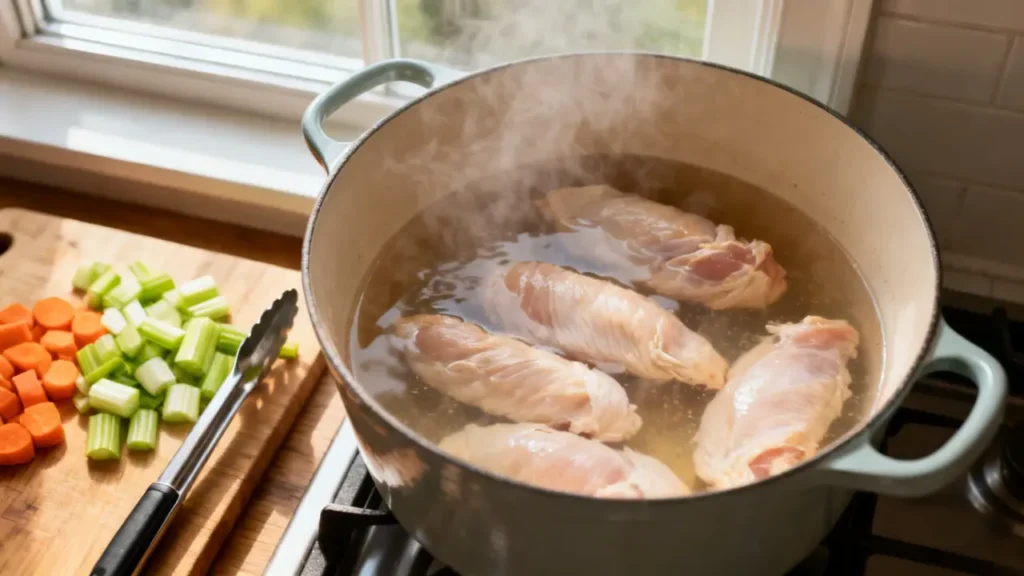

Quick answer: how long to boil chicken tenderloins to shred
The short, most useful answer is: poach chicken tenderloins at a gentle simmer (about 180–190°F / 82–88°C) for 4–6 minutes for fresh small tenderloins, 6–8 minutes for larger/thicker pieces, and 8–12 minutes if cooking from frozen. Always confirm doneness with an instant-read thermometer — the safe final temperature is 165°F (74°C).
Times vary by thickness and starting temperature; a thin grocery tenderloin will finish much faster than a thick, meaty one. We recommend removing tenderloins at about 160°F (71°C) and resting them for 4–7 minutes to allow carryover cooking to reach 165°F, which keeps meat juicier. A gentle simmer gives tender, shreddable meat — a rolling boil will make shreds stringy and dry.
Why tenderloins cook so fast (and why that matters)
Chicken tenderloins are small, thin strips of muscle with less connective tissue than breasts or thighs, so they heat through quickly and take less time to reach a safe temperature. Because they’re thin, heat penetrates to the center in minutes and the muscle proteins tighten quickly if exposed to high, turbulent heat.
That’s why we use a poach method — bring the liquid up to a gentle simmer, not a rolling boil, to avoid aggressive agitation that squeezes out moisture. The difference is not just feel: a simmer around 180–190°F (82–88°C) produces tender, shreddable meat while a rapid boil tends to create dry, stringy shreds.
Ingredients & equipment
You don’t need fancy gear to poach tenderloins — a medium pot and an instant-read thermometer are the two items we won’t skip. Use a shallow pot so the tenderloins lie in a single layer and are covered with liquid; that helps them cook evenly and makes checking doneness easier.
- Chicken tenderloins (1 lb serves ~3–4)
- Liquid: water or low-sodium chicken broth — plan roughly 4 cups per pound or just enough to cover
- 1 tsp kosher salt per quart (or 3/4 tsp table salt)
- Aromatics: 1/2 onion (quartered), 2 smashed garlic cloves, 1 bay leaf, 8–10 peppercorns
- Instant-read thermometer, slotted spoon, shallow pan or bowl for resting
- Optional: stand mixer with paddle or two forks for shredding
Step-by-step method (best practice)
Start by seasoning and preparing your tenderloins, heat your poaching liquid to a gentle simmer, cook to the times below while checking temperature, then rest before shredding. This sequence — prep, simmer, thermometer check, rest — is the reliable path to moist, shreddable chicken.
1) Prep and seasoning
Pat the tenderloins dry and trim any loose bits; there’s no need to rinse. For quick, built-in flavor add aromatics and 1 tsp kosher salt per quart of liquid; if you have time a 30-minute brine (1/4 cup salt to 4 cups water) will give slightly better seasoning.
2) Heat the liquid (how to)
Put the liquid and aromatics in a shallow pot and bring to a gentle simmer — you should see small bubbles and occasional movement but not a rolling boil. Aim for approximately 180–190°F (82–88°C); if you don’t have a thermometer, watch for tiny bubbles on the sides and a steady steam without violent bubbling.
3) Cooking times by starting state and size
Cook tenderloins to the following ranges at a gentle simmer and always verify with a thermometer: fresh small tenderloins: 4–6 minutes; larger/thicker tenderloins: 6–8 minutes; frozen (no thaw): 8–12 minutes. These are guidelines — thickness and pot size change the time, so the thermometer is the final authority.
For safety and best texture remove the chicken at about 160°F (71°C) and let it rest for 4–7 minutes so carryover heat brings it to 165°F (74°C). If you prefer to be conservative, cook to a final 165°F before removing, but note that a short rest after 160°F gives juicier results.
4) How to check doneness (thermometer + visual cues)
Insert an instant-read thermometer into the thickest part of the tenderloin — it should read 165°F (74°C) when done or reach 160°F before resting. Visually the meat should be fully opaque with no pink streaks and the juices should run clear when cut.
If you don’t have a thermometer, use touch and appearance: the tenderloin will feel firm but springy (not floppy) and the center will be opaque. Still, thermometers are cheap and remove the guesswork — they’re the best investment for consistent results.
5) Resting & why it’s important
Rest the cooked tenderloins on a plate for 4–7 minutes before shredding so juices redistribute and carryover cooking finishes the center. Skipping the rest means more juices run out during shredding and your chicken will be drier.
Reserve a small cup of the poaching liquid to moisten shredded chicken if needed — it’s a great way to restore juiciness without adding fat. We always keep some liquid aside when we poach larger batches for meals later in the week.
How to shred chicken tenderloins (methods & timing)
The fastest and most controlled methods are using two forks or a stand mixer; a food processor can work but risks overprocessing. For small home batches two forks produce nice strands in about 30–60 seconds; a stand mixer with the paddle on low takes 10–20 seconds.
Two forks
Pull the tenderloin apart along the grain with two forks, holding one steady and dragging the other. Two forks give the most control and the best texture for tacos and salads; expect about 30–60 seconds per handful.
Stand mixer (our go-to for batches)
Place warm (not piping hot) tenderloins in the stand mixer bowl, use the paddle on low, and pulse for 10–20 seconds until you see shredded strands. This method is the quickest and most even for 1–2 pounds, but watch carefully: leave it running too long and you’ll end up mushy.
For a step-by-step on shredding technique, see our longer guide on How to shred chicken which compares forks, stand mixers, and processors and shows photos of the ideal texture.
Food processor (use with caution)
If you must use a food processor, pulse 2–3 short times and check — it’s easy to go from shredded to paste in a few seconds. Reserve this for recipes that need finely shredded or ground chicken; otherwise use forks or a mixer for better texture.
Flavoring tips while poaching
Poaching liquid is your chance to infuse subtle flavor: use a low-sodium broth, a halved onion, smashed garlic, a bay leaf, and a few peppercorns and simmer for the entire cook. Salt is important for seasoning the interior — we use 1 tsp kosher salt per quart of liquid as a baseline.
Add a splash of acid (1 tbsp white wine vinegar or lemon juice) after cooking to brighten the flavor; acid added while poaching can firm the meat slightly. If you want more pronounced flavor, simmer aromatics for 10 minutes before adding chicken so the liquid is already fragrant.
Troubleshooting: common mistakes and fixes
The most common mistake is boiling too hard — a vigorous rolling boil will beat the tenderloins and make the shreds dry and stringy. If your chicken is dry, shred it and warm it gently in reserved poaching liquid or broth — a few minutes on low will rehydrate the shreds.
Another issue is undercooking; if shreds look pink inside, return them to the simmer for a minute or two in a little broth rather than microwaving dry. I learned the hard way that crowding the pot drops the liquid temperature and stretches cooking time — now I use a wide shallow pot so pieces cook evenly.
If shredded chicken tastes bland, add a tablespoon of the poaching liquid plus a squeeze of lemon, or toss with a tablespoon of mayo or olive oil and a pinch of salt to improve mouthfeel. For sticky or gummy shreds from over-processing, toss with a little warm broth and let rest 10 minutes — texture improves slightly as strands relax.
Storage & make-ahead
Cool cooked chicken quickly and refrigerate within 2 hours. Stored in an airtight container it will keep 3–4 days in the fridge; freeze in flat labeled bags for up to 3 months.
To cool fast, spread shredded chicken in a shallow pan or seal in a zip-top bag and rest the bag in an ice bath to drop the temperature before refrigerating. If you plan to freeze, remove as much air as possible, label with the date and intended use, and freeze in portion sizes so you only thaw what you need.
For full tips on freezing and reheating without drying, check our guide on How to store and freeze cooked chicken safely.
Quick recipe ideas for shredded tenderloins
Shredded tenderloins are versatile: toss with taco seasoning and lime for tacos, mix with mayo and celery for a quick chicken salad, or fold into enchiladas with salsa. They’re also perfect tossed with BBQ sauce for sandwiches or warmed into a gentle curry with coconut milk.
If you want a recipe that uses poached shredded chicken, try our simple enchilada filling — we test it with both fresh and frozen tenderloins and the timing below works well: see How to boil chicken for enchiladas for a ready-to-go method.
Summary cheat sheet
Here’s a quick reference you can screenshot or print: simmer temp 180–190°F (82–88°C); fresh small tenderloins 4–6 minutes; large 6–8 minutes; frozen 8–12 minutes. Remove at 160°F and rest 4–7 minutes or cook to 165°F before serving.
- Simmer: 180–190°F / 82–88°C
- Fresh small: 4–6 minutes
- Large: 6–8 minutes
- Frozen: 8–12 minutes
- Rest: 4–7 minutes (carryover to 165°F)
Want a deeper comparison of poaching vs other cooking methods? Read our post on poaching vs baking and grilling to decide which method fits your recipe and schedule. For more on boiling tenderloins specifically, our related guide How to boil chicken for shredding walks through photos and timing for different sizes.


