
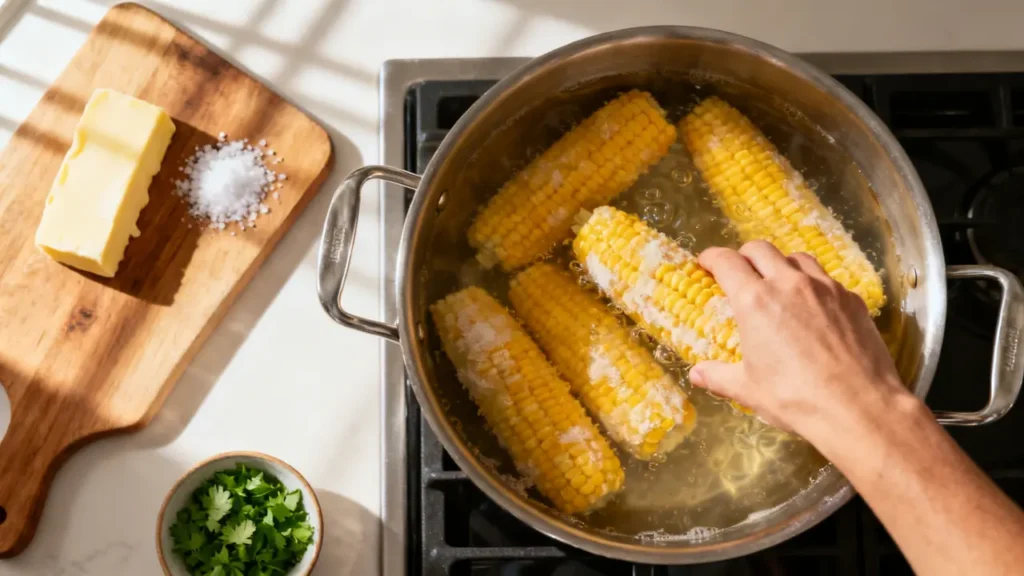

We tested the easiest method for how long to boil corn on the cob from frozen so you get plump, sweet kernels fast. Bring a pot of water to a rolling boil, add shucked frozen ears, wait for the water to return to a boil, then cook by ear size listed below. No thawing needed.
Quick answer: timing at a glance
The short answer for how long to boil corn on the cob from frozen is: add shucked frozen ears to boiling water, bring back to a boil, then cook 6–8 minutes for small ears, 8 minutes for standard ears, and 9–12 minutes for very large ears. Kernels (shucked and loose) usually need only 3–5 minutes to reheat.
This timing assumes sea level conditions where water boils at 212°F (100°C). If you’re at altitude, see the troubleshooting section for adjustments. Treat the timer as starting when the water is actively boiling again after adding the frozen corn.
Step-by-step: how to boil frozen corn on the cob
Start by bringing a pot of water large enough to hold the ears to a rolling boil, then add the frozen, shucked ears directly—do not thaw. Cover to speed the return to a boil, then once boiling again, start your timer based on ear size and cook until done.
Use a pot with enough water to fully submerge the corn; we usually use a 6- to 8-quart (6–8 L) pot for 6–8 ears. Keep the lid on while the water comes back to a boil to retain heat, then lower to a gentle boil so kernels stay intact.
What you need
You only need a large pot, enough water to cover the ears, tongs, and a timer. For a crowded pot or more than 8 ears, heat loss will increase return-to-boil time; keep the lid on. We recommend a 6–8 quart (6–8 L) pot for a family-sized batch.
The basic method
Bring water to a rolling boil, add the frozen ears straight in, cover, and wait for the water to return to a boil. When the pot reaches a full boil again, start the timer and cook for the time that fits your ear size, then remove and drain.
- Fill a pot with enough water to cover the corn and bring to a rolling boil.
- Remove frozen ears from packaging and add them to the boiling water; cover the pot to speed heating.
- When the water returns to a full boil, start the timer and cook: see the timing chart below.
- Use tongs to remove ears, drain briefly, and serve hot with butter or your favorite topping.
Timing chart: cheat sheet
Here’s a quick reference for how long to boil corn on the cob from frozen depending on ear size or form. Start timing when the water is boiling again after you add the frozen corn.
- Small ears (skinny, short): 6–8 minutes
- Standard ears (7–9 inches | 18–23 cm): 8 minutes
- Large ears (thick, extra-long): 9–12 minutes
- Half cobs / pre-cut ears: 4–6 minutes
- Shucked kernels (frozen): 3–5 minutes
Note that most commercial frozen sweet corn is blanched before freezing, so you’re mostly reheating, not cooking raw kernels through. That explains the short times compared with raw fresh corn.
Why timing varies: the simple science
Most frozen sweet corn is blanched before freezing, which partially cooks the kernels and locks in sugars. Because of that, frozen corn needs only reheating rather than a full cook, so it often finishes in a fraction of the time fresh, raw corn would require.
Other factors that change timing are ear size, how cold the corn is straight from the freezer, pot size, and how many ears you add at once. Adding a dozen ears to a small pot will drop the water temperature more than adding two, so return-to-boil time increases.
Best practices and chef tips
Keep the lid on while the water returns to a boil to reduce heat loss, but reduce agitation once boiling again to avoid jostling kernels off the cob. For consistent results, start your timer when the water is visibly and vigorously boiling again.
We usually season after cooking: add butter, salt, pepper, or try our favorite takes like Mexican-style toppings. For more on flavoring after cooking, see our Mexican street corn notes and the sugar-in-water option at boiling with sugar.
Salt, sugar, and the water
Salting the water won’t make kernels tough, but it doesn’t do much for interior seasoning. We prefer to salt after cooking so the seasoning hits the hot surface. Some cooks add a teaspoon of sugar per quart to enhance sweetness—use sparingly and taste first.
Pro tip: butter and salt after draining gives better surface flavor than trying to infuse the water. If you want to caramelize or roast flavors, finish under a broiler or on a grill.
Troubleshooting: common mistakes and fixes
If kernels are undercooked: return them to boiling water and continue in small increments, testing with a fork every minute or two until tender. If the center of the cob is frozen or cold, cook another 1–3 minutes depending on size.
If kernels are mushy from overcooking, immediately plunge the ears into an ice bath or rinse under cold water to stop carryover cooking; then use the corn in salads, salsas, or fritters. Cloudy or foamy water is normal and usually just starch released from the corn.
I learned the hard way that crowding the pot is the fastest route to inconsistent results—once I tried to boil a double batch in a small pot and ended up with some ears overcooked and some underdone. Now I split large batches between pots or work in shifts.
High-altitude and batch-cooking notes
At high altitude the boiling point is lower so water has less cooking power; add about 1–2 minutes to the recommended times above if you’re over 3,000 ft (≈900 m). Always use sensory checks (fork test) rather than relying solely on the clock.
For batch cooking, keep the pot covered and bring water back to a boil before starting the timer. Adding more ears increases return-to-boil time but the cook time itself is counted only after the water fully returns to a boil.
Alternatives with exact timings
If you don’t want to boil, steaming takes about 6–8 minutes for whole frozen ears. Microwave a frozen ear on a plate wrapped with a damp paper towel for 3–5 minutes depending on wattage, turning halfway. For oven roasting, wrap in foil and roast at 375°F (190°C) for 15–20 minutes.
Air fryer method: cook whole frozen ears at 400°F (200°C) for about 10–12 minutes, turning halfway to brown the kernels. For more on reheating without drying, check our guide at reheating corn.
Serving ideas
Keep it simple with butter and salt, or try herb butter with lemon zest, a sprinkle of cotija and chili powder for street-corn style, or garlic-parmesan finish. For a full elote recipe and assembly tips, see our Mexican street corn page.
Quick ideas: brush with chili-lime butter, toss with chopped herbs and feta, or slice kernels off the cob for salads and salsas. Overcooked ears make excellent corn fritters or chowders.
Storage and reheating
Store boiled ears in an airtight container in the fridge for up to 3–4 days. For longer storage, slice the kernels off and freeze in a shallow container for up to 6 months after cooling completely.
Reheat gently: microwave with a damp paper towel for 1–2 minutes, steam for 2–3 minutes, or grill briefly to refresh flavor without drying. If you want to freeze cooked corn, see our notes on prepping corn for freezing at how to boil corn for freezing.
Related posts
Looking for more corn tips and recipes? Read our notes on boiling frozen corn, the elote recipe, and flavoring tips at boiling with sugar.


