
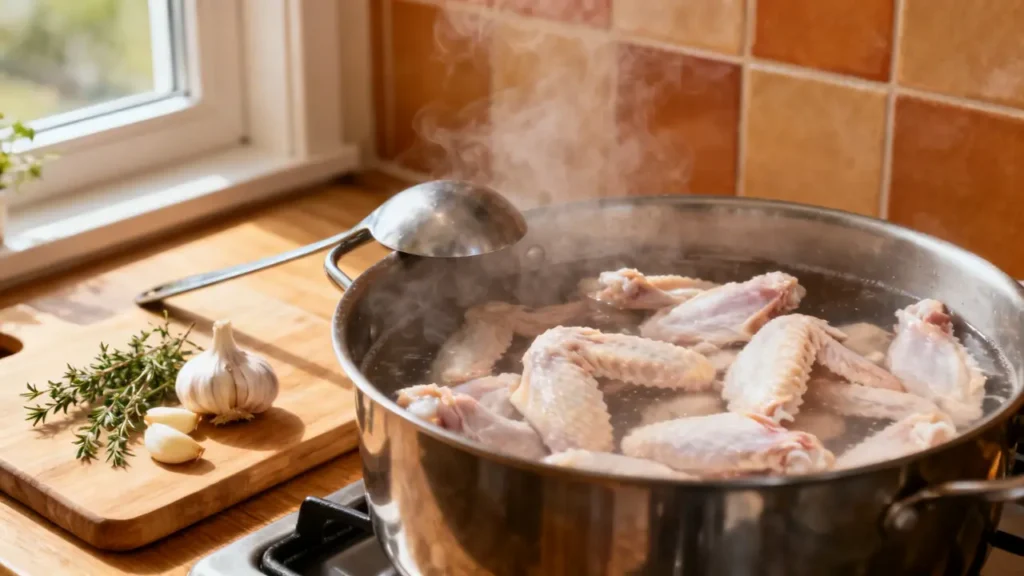

Short Answer — Yes, you can (and here’s how long)
Yes — you can boil frozen chicken wings. On the stovetop, plan for about 12–25 minutes from frozen depending on wing size (small: 12–15 min, medium: 15–18 min, large: 18–25 min); in an Instant Pot expect 10–12 minutes at high pressure plus a 5–10 minute natural release. The definitive check is a probe thermometer: the internal temperature must read 165°F (74°C).
We use time ranges because wings vary by weight and whether they arrive as single pieces or frozen clumps. Always treat the thermometer as the final say — times are guidance but don’t replace a temperature check in the thickest part next to the bone.
Safety basics & USDA guidance
USDA requires poultry reach a minimum internal temperature of 165°F (74°C) — that applies whether wings start frozen or thawed. Cooking from frozen is allowed, but expect extra time because ice inside the wings has to heat and evaporate before the meat reaches temperature.
Handle frozen packaging carefully: discard or wash outer packaging and wash hands and surfaces after touching raw frozen poultry. If packaging is torn and juices leak, rinse the wings briefly under cold water while avoiding splashes, then cook; this reduces cross-contamination risk.
Why you should poach/simmer (not aggressive boiling)
Poaching or a gentle simmer keeps wings tender and stops the skin from tearing; vigorous rolling boil tightens proteins and can make skin rubbery or the meat stringy. A gentle simmer transfers heat evenly and reduces the chance bones form undercooked pockets while the surface overcooks.
For best texture, bring the liquid to a boil, drop in the wings, then reduce heat so the surface shows small bubbles and occasional movement — not a furious boil. This also helps aromatics infuse while keeping meat moist.
Exact cooking times — stovetop, by wing size
Use size as your timing guide: small wings (under 2 oz): 12–15 minutes, medium (2–3 oz): 15–18 minutes, and large (over 3 oz): 18–25 minutes from frozen in simmering water. If you want the meat fall-apart tender (for shredded wing meat), push to 175–185°F (79–85°C), but expect slightly longer cooking and softer skin.
Thawed wings are quicker: roughly 8–12 minutes in simmering water. If wings are frozen together in a clump, separate them if possible; if not, add about 25–30% extra time (roughly 4–6 minutes for a batch) and always use the thermometer.
Quick table (stovetop) — times are from frozen and assume a gentle simmer:
| Wing size | Stovetop (minutes) | Instant Pot (high pressure) |
|---|---|---|
| Small (≤2 oz) | 12–15 | 10 + 5–10 min NPR |
| Medium (2–3 oz) | 15–18 | 10–12 + 5–10 min NPR |
| Large (≥3 oz) | 18–25 | 12 + 5–10 min NPR |
Instant Pot / Pressure cooker timing (from frozen)
Pressure cooking is fast and forgiving for frozen wings. Use 10–12 minutes on high pressure for most batches and let the pressure release naturally for 5–10 minutes (NPR) to avoid violent liquid splatter and to finish gently. Always check the thickest part reaches 165°F (74°C).
Set the IP on high, add 1 cup of water or broth (or 1/2 cup beer + 1/2 cup water for flavor), stack wings on a trivet or use a sling so they aren’t all sitting on the bottom. If wings are very large, favor 12 minutes and a slightly longer NPR.
How to check for doneness (thermometer placement + visual cues)
Insert the probe into the meatiest part of the wing — the drumette or the thick part of the flat — aiming for the center near the bone but not touching the bone. 165°F (74°C) is the safety minimum; 175–185°F yields softer, shreddable meat.
Visual cues: juices should run clear (not pink), meat should separate slightly from the bone, and the skin will look opaque and slightly loose. Never rely on color alone — use the thermometer to rule out undercooked bone pockets.
Step-by-step stovetop method (with times and quantities)
This is our reliable stovetop workflow: fill a pot so wings are covered by about 1 inch of liquid, bring to a boil, add wings, then reduce to a gentle simmer and time by size. Use 1 tsp salt per quart (liter) of water as a baseline; we season more later if finishing with sauce.
Equipment and ingredients: medium pot, probe thermometer, slotted spoon, 4–6 quarts water per 2–3 lb wings, 1 tsp salt per quart, 1 onion halved, 3 garlic cloves smashed, 1 bay leaf, 8–10 peppercorns. Photo tip: take a shot of the frozen wings going into the pot so you remember starting volume and placement.
- Bring the poaching liquid to a boil.
- Add frozen wings in a single layer if possible, return to a brief boil, then lower heat to a gentle simmer.
- Simmer for the time that matches wing size (see table above), stirring once to separate any stuck pieces.
- Check internal temp in the thickest part near the bone — confirm 165°F (74°C).
- Remove wings to a wire rack for crisping or proceed to finishing method.
Sample timed workflow: total ~35–40 minutes. 0:00–5:00 bring liquid to boil and add aromatics, 5:00–25:00 simmer wings (times vary by size), 25:00–30:00 crisp in air fryer or oven, 30:00–35:00 toss in sauce and rest 5 minutes.
Best poaching liquids & flavor variations
Poaching liquid is your flavor baseline. We recommend 1 tsp salt per quart as a start and add aromatics to taste. The flavor in the liquid will season the meat but some will be lost when you crisp and sauce, so keep sauces a bit assertive.
Three reliable poaching liquids we use: basic salted water (1 tsp salt/quart, onion, garlic, bay leaf), beer + water (1/2 can beer + 1/2 cup water per quart, 1 tsp salt), and Asian-style (2 cups low-sodium broth per quart, 2 tbsp soy sauce, 1 tbsp rice vinegar, sliced ginger, 2 garlic cloves). Each gives distinct, dependable results.
How to finish wings for crisp skin (oven, air fryer, skillet, deep-fry)
Boiling gets wings cooked and juicy; to crisp the skin you must use high, dry heat briefly. Our go-to is the air fryer or a hot oven — both are fast and hands-off and preserve the juiciness you developed while poaching.
Oven
Arrange wings on a wire rack over a sheet pan and roast at 425°F (218°C) for 10–15 minutes until the skin crisps and edges brown. Broil 1–2 minutes at the end if you want extra color, watching closely to avoid burning.
Air fryer
Preheat to 400°F (204°C) and air-fry wings in a single layer for 6–10 minutes, shaking once halfway. This is our favorite quick finish for crispy skin without extra oil.
Skillet / Deep-fry
For a skillet crisp, heat 2 tbsp oil to medium-high and sear wings 2–3 minutes per side. For deep-frying, heat oil to 350–375°F (175–190°C) and fry 2–4 minutes until golden. Always pat wings dry first and be careful with hot oil and water from poaching.
Sauce after crisping for best texture: toss wings in sauce just before serving, or glaze and briefly broil to set the sauce.
Troubleshooting & common mistakes
Frequent errors include overboiling (rubbery skin), underchecking the bone pocket (pink meat near bone), and crowding the pot (lowers liquid temp and increases cook time). Don’t rush with high, rolling boil — simmer gently.
- Rubbery skin: you boiled too aggressively or overcooked — finish in hot oven/air fryer to restore crispness.
- Watery flavor: use a flavorful poaching liquid (broth, beer, aromatics) and finish with a strong sauce.
- Wings stuck together: separate frozen clusters before cooking or add an extra 4–6 minutes and check temp carefully.
Personal note: I once tossed a full frozen bag into the pot without separating the pieces — the inside of that clump stayed cold long after the surface was done. Since then I always pry pieces apart or add a few extra minutes and double-check with a thermometer — lesson learned the hard way.
Storage, reheating & can you refreeze?
Cool cooked wings and refrigerate within 2 hours. Store in an airtight container for 3–4 days in the fridge. To reheat, use an air fryer at 375°F (190°C) for 4–6 minutes to crisp without drying.
You can refreeze cooked wings if they were cooled and stored properly, but expect some texture loss. For best leftovers, freeze within 2 hours in a freezer-safe container and use within 2–3 months for quality.
Printable recipe card & 30–45 minute timed workflow
Here’s a compact recipe card for the popular poach→air-fry finish. Total active time about 30–40 minutes depending on wing size and crisping choice.
- 2–3 lb frozen chicken wings
- 4–6 cups water or broth
- 1 onion halved, 3 garlic cloves, 1 bay leaf, 8 peppercorns
- Salt: 1 tsp per quart of liquid
- Bring liquid + aromatics to a boil in a pot big enough to cover wings.
- Add wings, return to boil, then reduce to a gentle simmer. Cook per size table above.
- Check a drumette — thermometer must read 165°F (74°C).
- Remove to wire rack and air-fry at 400°F/204°C for 6–8 minutes or roast at 425°F/218°C for 10–15 minutes to crisp.
- Toss in sauce and serve hot.
Timed workflow (example, medium wings): 0–5 min heat and prep, 5–22 min simmer, 22–30 min air-fry crisp, 30–33 min toss in sauce, 33–35 min rest and serve.
Quick internal resources
Want to dig deeper? Read our Instant Pot Chicken Wings: Fast & Tender for pressure-cooker specifics, check the How to Tell When Chicken Is Done — Thermometer Guide for probe placement and temp tips, and explore wing sauces in our Best Wing Sauces: Buffalo, BBQ, Asian Glaze roundup.
Photo checklist (step shots to capture)
Take three quick photos to help readers follow your steps: frozen wings in the pot (so quantities are evident), thermometer placement in the thickest part near the bone, and wings arranged on a wire rack ready for oven/air fryer. These visuals make timing and technique obvious at a glance.


