
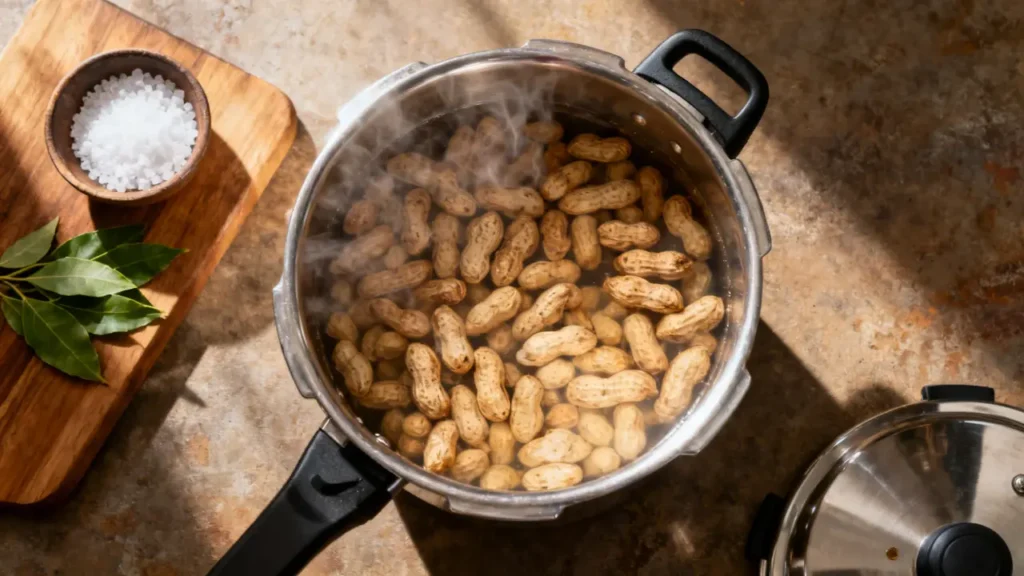

How to Boil Groundnuts (Peanuts) in a Pressure Cooker
Pressure cooking groundnuts (peanuts) delivers tender, salty snacks faster and more consistently than simmering — and it works with both a traditional stovetop pressure cooker and an electric Instant Pot. Use the electric minute ranges for reproducible results: fresh/green peanuts about 8–12 minutes high pressure; raw/dry peanuts about 20–25 minutes high pressure, followed by a 10-minute natural release. We’ll also show whistle-to-minute conversions for stovetop users, precise water ratios, salt measurements, soak options, flavor variations, troubleshooting, and storage advice so you can make perfect boiled peanuts every time.
Which Type of Peanuts to Use
Use fresh/green peanuts if you can — they’re harvested moist, have thin shells, and become tender quickly; use raw/dry peanuts (shelled or unshelled) when fresh ones aren’t available, but expect longer cook times. Fresh/green peanuts should be steam-tender after 8–12 minutes high pressure in an electric cooker; raw/dry peanuts need about 20–25 minutes.
Fresh/green peanuts have higher moisture and a softer interior, so they cook faster and taste sweeter; raw/dry peanuts are denser and slightly chalky at first and soften more slowly. If you buy commercial roasted peanuts, do not use them for boiling — they’ll be dry and won’t absorb the brine properly.
- Fresh/green: 8–12 min HP (Instant Pot); 2–3 whistles (stovetop)
- Raw/dry: 20–25 min HP (Instant Pot); 4–6 whistles (stovetop)
Ingredients & Equipment (exact ratios)
Start with rinsed peanuts and plain water; for predictable results use a ratio of roughly 3 cups (720 ml) water per 1 cup (about 140–150 g) raw peanuts, or enough water to sit 1–2 inches (2.5–5 cm) above the peanuts. For salt, use a starter guideline of 1 tablespoon kosher salt (or 1.5 tsp table salt) per 2 cups (≈250 g) raw peanuts, and adjust after tasting your first batch.
Equipment matters: a 6–8 quart stovetop pressure cooker or a 6–8 quart Instant Pot gives the right headspace. For electric cookers, check your sealing ring is clean and in good condition; for stovetop cookers, verify the vent/weight and gasket. If you plan spicy or aromatic versions, add bay leaves, garlic, or Cajun seasoning — we list amounts below.
- Peanuts: fresh/green or raw/dry (unshelled or shelled; see notes)
- Water: ~3 cups per 1 cup peanuts (or 1–2 inches above)
- Salt: 1 Tbsp kosher salt per 2 cups peanuts (≈250 g)
- Optional aromatics: 2–3 cloves garlic, 1–2 bay leaves, 1–2 Tbsp Cajun seasoning, 1–2 Tbsp brown sugar
- Equipment: stovetop pressure cooker or Instant Pot (6–8 qt recommended)
Prep Options — To Soak or Not to Soak
Soaking peanuts for 4–8 hours or overnight reduces high-pressure cook time by roughly 20–30% and helps evenly hydrate very dry nuts; it’s a helpful step if your peanuts are older or very dry. If you’re short on time you can skip soaking — just expect the longer cook times (we give both sets of times in the methods below).
Quick soak: cover peanuts with warm water and salt, bring to a simmer for 10–15 minutes, then cool and refrigerate for an hour before pressure cooking — this speeds things along. No-soak method: rinse the peanuts and use the full water ratio and the longer pressure times listed; the texture will still be excellent with the electric minute ranges.
Method A — Stovetop Pressure Cooker (traditional whistles)
For stovetop pressure cookers, bring to pressure then count whistles or use minute ranges: fresh/green: 2–3 whistles (≈8–12 minutes after pressure builds); raw/dry: 4–6 whistles (≈18–25 minutes after pressure builds). These ranges account for vent style differences — always check a few nuts for texture before finishing.
How to do it: add rinsed peanuts, water (1–2 inches above), and salt to the cooker; seal and heat until the cooker reaches pressure. Maintain medium-high heat so the cooker cycles normally, then start counting whistles or time from when pressure is reached; after the final whistle, turn off heat and let the pressure drop partially for at least 10 minutes (natural rest) before venting fully and checking doneness.
- Rinse 1 cup raw peanuts; place in pressure cooker with ~3 cups water and 1/2 Tbsp kosher salt (see salt section for scale).
- Seal cooker and heat to build pressure; then cook for whistles or minutes above.
- After the final whistle, remove from heat and let rest 10–15 minutes for a partial natural release; then vent fully and test a peanut.
- If undercooked, reseal and cook an additional 5–10 minutes (raw/dry) or 3–5 minutes (fresh) — practical troubleshooting below.
Safety note: never overfill a stovetop pressure cooker more than two-thirds full with solids and liquids — a full pot blocks vents and is dangerous. Also avoid rapid cool-down with cold water while still under pressure.
Method B — Electric Pressure Cooker / Instant Pot
For reproducible results in an electric cooker, use High Pressure and the minute ranges below, then allow a 10-minute natural release (NR) to finish cooking and prevent split shells. Fresh/green: 8–12 minutes HP + 10 min NR. Raw/dry: 20–25 minutes HP + 10 min NR. If soaked, reduce HP time ~25% (raw/dry soaked ≈ 15–18 min).
Steps: add peanuts, water, and salt; seal the lid, set valve to sealing, select Pressure Cook / Manual at the time recommended for your peanut type, then let the unit do its work. After the cook cycle ends, let the cooker sit for 10 minutes (natural release), then release the remaining pressure and check a peanut for doneness.
- Rinse peanuts and add to Instant Pot with ~3 cups water per 1 cup peanuts and salt.
- Close lid, set valve to sealing, Pressure Cook on High for the time above (8–12 or 20–25 minutes).
- Allow 10 minutes natural release, then quick-release any remaining pressure. Test a peanut; reseal and add 5–10 min HP if too firm.
Pro tip: if cooking several pounds, do not crowd the pot — keep to about two-thirds of the pot’s capacity for even pressure and proper water coverage. For reproducible results we prefer the electric minute ranges; whistles are less consistent because vent designs differ from cooker to cooker. For more on safe pressure-release practice see our link to Instant Pot resources below.
Learn more about electric pressure-cooker safety and pressure release in our Instant Pot basics guide: Instant Pot pressure tips. For Instant Pot-style boiled-peanut specifics see Instant Pot boiled peanuts.
Flavor Variations & Seasoning Ideas
Boiled peanuts take flavor well — add aromatics and seasonings to the cooking water so the nuts absorb them. Add spices before cooking for deeper flavor; finish with a sprinkle after cooking for brightness. Classic salted, spicy Cajun, garlicky-masala, and sweet-salty versions all work; we list amounts and when to add them below.
Classic salted: add 1 Tbsp kosher salt per 2 cups peanuts to the water before cooking. Spicy Cajun: add 1–2 Tbsp Cajun seasoning + 1 tsp cayenne for 2 cups peanuts. Garlicky-masala: toss in 2 smashed garlic cloves and 1 Tbsp garam masala. Sweet-salty: add 1–2 Tbsp brown sugar to the water and reduce salt slightly.
Troubleshooting — Fixes and Common Mistakes
If your peanuts are undercooked and chalky, simply reseal and cook again: add 5–10 minutes high pressure for raw/dry peanuts or 3–5 minutes for fresh/green. If they’re mushy, you likely overcooked them or used too much water/too much heat; reduce time next batch and shorten the natural release.
Too salty? Rinse briefly in warm water and re-soak in fresh water for 10–20 minutes to pull salt back out, or dilute with unsalted boiled peanuts. Too bland? Reheat with extra salt in a small pot for 5–10 minutes to let flavors penetrate. Altitude adjustments: at higher altitudes, add roughly 5–10% more pressure-cook time per 1,000 feet above sea level.
Common mistakes we see at home: overfilling the cooker, ignoring headspace, and skipping the 10-minute natural release — these create uneven texture or blown seals. Follow headspace limits and the 10-minute NR for best results.
Personal note: I used to overfill the Instant Pot when making big batches and ended up with undercooked centers. Learning to keep the pot two-thirds full and split into two batches solved it — the pressure builds properly and texture becomes consistent.
Cooling, Storage & Shelf Life
Cool boiled peanuts to room temperature before refrigerating, but don’t leave them out more than two hours. Store in a sealed container in the fridge for 3–5 days; for longer storage freeze in airtight bags for up to 3 months. Reheat frozen peanuts by simmering in a little water for 5–10 minutes to rehydrate.
If you want true long-term shelf stability, consult official canning guidelines — canning boiled peanuts requires pressure canning and USDA/Ball guidance. For freezing and quick reheats see our guide on how to freeze boiled peanuts and tips for keeping texture.
Quick Reference — Salt, Water & Times
Here’s a compact summary so you can scroll back to cook: water ≈ 3 cups per 1 cup peanuts, salt ≈ 1 Tbsp kosher per 2 cups peanuts, and electric cooker times: fresh/green 8–12 min HP + 10 min NR, raw/dry 20–25 min HP + 10 min NR. For stovetop, use whistles conversions listed earlier.
- Water: ~3 cups (720 ml) per 1 cup peanuts or 1–2″ above peanuts
- Salt: 1 Tbsp kosher salt per 2 cups peanuts (≈250 g)
- Instant Pot: Fresh 8–12 min HP / Raw 20–25 min HP (10 min NR)
- Stovetop: Fresh 2–3 whistles / Raw 4–6 whistles (use minutes as backup)
Printable Recipe Card — Quick & Detailed Methods
Quick method (1 cup peanuts): rinse 1 cup raw peanuts, add ~3 cups water and 1/2 Tbsp kosher salt, pressure-cook on High (Instant Pot) 20–25 min (raw) or 8–12 min (fresh), then natural release 10 minutes. Drain and cool briefly before serving.
Detailed method: follow the Instant Pot or stovetop steps earlier for scaled batches, split large batches to keep the cooker two-thirds full, and use the soak options if peanuts are very dry. Adjust salt to taste after the first batch and note it for future cooks.
Nutrition Snapshot
Boiled peanuts retain more water and are slightly lower in calories per cup than dry-roasted peanuts. A 1/2-cup serving (shelled) is roughly 150–200 calories with about 12–14 g fat and 8–10 g protein, depending on peanut type and how much salt you add.
Final Tips & Serving Suggestions
Serve boiled peanuts warm or at room temperature with a cold drink — they’re a great snack for gatherings, tailgates, or just nibbling while cooking. Sprinkle a little extra flaky salt or toss with chili powder after draining for a finishing kick.
Leftover ideas: shelled boiled peanuts are great folded into grain bowls, chopped into stews, or blended into a rustic boiled-peanut spread. If you want roasted peanuts instead, check our guide on other peanut methods and our roasting tips elsewhere on the site.
Common Mistakes & How to Avoid Them
Avoid these mistakes: overfilling the cooker, skipping the NR step, and using roasted peanuts. If a batch runs long and gets mushy, shorten time next run and reduce NR; if undercooked, reseal for an extra 5–10 minutes high pressure. Keep notes — this is the fastest route to repeatable success.
Related posts
Want to dive deeper? Check our Instant Pot-specific instructions Instant Pot boiled peanuts, learn how to freeze boiled peanuts for longer storage, and read about safe long-term preservation in how to preserve boiled peanuts. For reheating tips see how to heat up boiled peanuts.


