
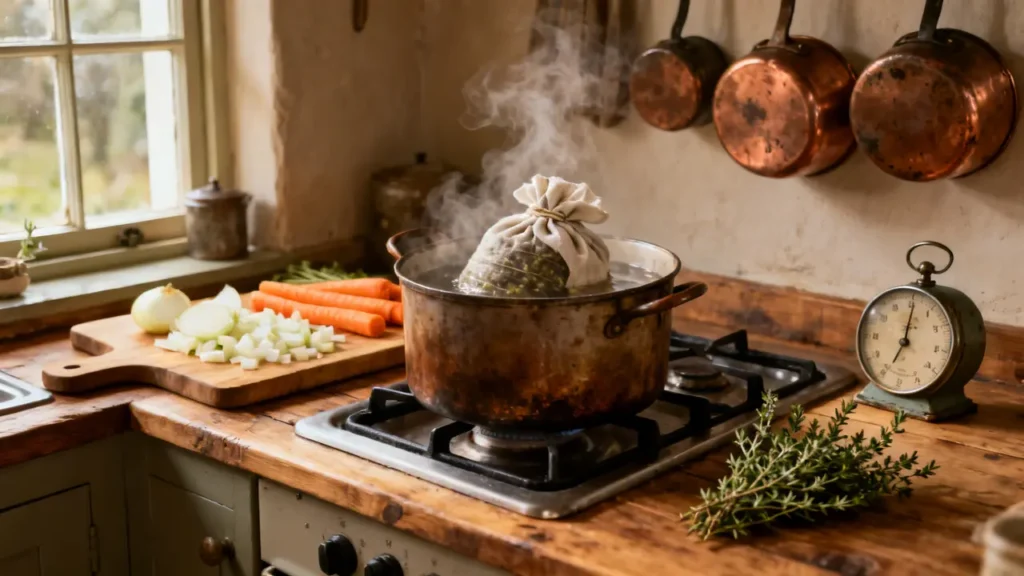

Learn how to boil a haggis – shop-bought, frozen or traditional stomach haggis – with clear, weight-based times and a thermometer target so it cooks safely. We include troubleshooting, reheating tips and simple Burns Night serving ideas. Plus a handy weight chart and safety numbers.
Which type of haggis do you have?
Start by identifying your haggis: is it a shop-bought pre-cooked vacuum pack, a frozen pre-cooked haggis, a fresh homemade haggis in a sheep’s stomach, or a vegetarian/vegan version? The type matters because cook times and prep change — raw stomach haggis needs the longest gentle simmer, while vacuum-packed pre-cooked haggis mainly needs reheating to 75°C (165°F).
Vacuum-packed haggis is usually pre-cooked; you’re bringing it to a safe serving temperature and protecting the casing. Frozen pre-cooked haggis can often be cooked from frozen but will take longer; check pack guidance and always confirm with a thermometer. Fresh or homemade haggis stuffed into a stomach is effectively raw meat and offal in a casing and needs a longer, more careful cook and hygiene attention.
Vegetarian haggis made from legumes and oatmeal behaves differently: it tolerates higher heat but can dry out, so treat it like a dense loaf and reheat gently. Knowing which type you have up front saves time and prevents the common mistakes of undercooking or bursting a delicate casing.
Quick answer — boil haggis in 60 seconds
Place the haggis in a large pan, cover with cold water, bring to a gentle simmer (aim for 85–95°C / 185–203°F) and simmer until the centre reaches 75°C (165°F) — about 1.5–2 hours for 1 kg shop-bought haggis. Remove, rest 10 minutes, then open and serve with neeps and tatties.
This one-paragraph method is perfect for most readers who want a straight, reliable route. If you’re cooking a raw stomach haggis, add another 30–60 minutes and follow the tying and hygiene steps below. Always use an instant-read thermometer rather than guessing by time alone.
Equipment & ingredients you’ll need
You’ll want a large heavy-bottomed saucepan or stockpot (big enough to fully submerge the haggis without crowding), a lid, a long-handled slotted spoon, kitchen string for tying, and an instant-read thermometer. Use a pot at least twice the haggis volume so water temperature stays steady and the casing isn’t knocked about.
Other small touches make a difference: tongs for gentle lifting, a tray or board for resting, and plenty of cold water for the initial cover. If you’re prepping a fresh stomach casing, have gloves, a clean bowl and butcher’s twine ready; hygiene and secure tying are essential for safety and to prevent leaks.
Step-by-step: Boiling a shop-bought / vacuum-packed haggis
Shop-bought vacuum-packed haggis is normally pre-cooked — you’re reheating it safely, not cooking raw meat through. Do not prick or slash the casing; that releases juices and increases the chance of the haggis bursting and becoming dry.
To prep, remove any outer packaging and place the sealed haggis into a large pot. Cover with cold water and slowly bring the pot up to a gentle simmer; avoid a rolling boil which stresses the casing and forces juices out. Aim for a simmer of about 85–95°C (185–203°F) — you can measure with an inexpensive kitchen thermometer or watch for occasional small bubbles and steam, not a violent boil.
Cook according to weight (see weight chart below) and check the centre with an instant-read thermometer inserted through the casing into the thickest part — you want 75°C (165°F). Remove with tongs, rest covered for 10 minutes so juices redistribute, then slice open carefully and serve.
Prep (ready-to-use vacuum-packed)
Leave vacuum-sealed haggis intact; the pack is a barrier and often designed to go into hot water. If instructions on the pack differ, follow the manufacturer; packs vary. When in doubt, remove vacuum packaging and treat the haggis as above — always confirm internal temp before serving.
Bring to a gentle simmer and cook
Start from cold water so the casing warms gradually; place the haggis in the pot, fill to cover by at least 2–3 cm, put on medium heat and watch the thermometer. Keep it at a gentle simmer — small steady bubbles and steam — which corresponds to 85–95°C (185–203°F). Times vary by weight; always confirm the centre is 75°C (165°F).
Finishing & resting
When the thermometer reads 75°C (165°F) in the centre, remove the haggis with tongs and let it rest, covered, for 10 minutes. Resting makes it easier to carve or spoon and helps the filling set slightly so it doesn’t crumble. Serve with mashed turnips (neeps) and mashed potatoes (tatties) or a whisky sauce.
Step-by-step: Boiling a fresh / homemade haggis in a sheep’s stomach
Fresh haggis stuffed into a sheep’s stomach is essentially raw meat and offal sealed in a casing and needs careful prep and a longer gentle simmer to cook safely. Handle with clean hands or gloves, rinse thoroughly and tie securely — any leaks risk undercooking and contamination.
Start by soaking the stomach in cold salted water for at least 30 minutes and rinse inside and out until clean; change water if it looks murky. Pat dry, stuff according to your recipe, then use butcher’s twine to sew or tie the openings tightly and reinforce weak spots with extra string or a small strip of netting.
Place the prepared stomach haggis in a large pot, cover with cold water, and bring to a gentle simmer. For fresh stomach haggis add roughly 30–60 minutes to the pre-cooked timings — many cooks expect 2–3 hours depending on size — and always confirm 75°C (165°F) at the centre with a thermometer.
Pre-cleaning & prepping the stomach
Soak the stomach in salted cold water for 30–60 minutes, turn it inside out to rinse away debris, and pat dry. Use gloves and keep surfaces clean; raw offal is more prone to bacterial contamination so good hygiene matters. If the stomach smells strong after rinsing, give it another short soak — a lightly saline rinse helps.
Securing & tying the stomach
Tie the neck and the filling end snugly with butcher’s twine and consider a second loop around the middle to reduce stress on a thin spot. Do not overfill; leave space for expansion during cooking. Sew any raw edges or use a double knot and trim excess twine so nothing floats loose and risks tearing the casing while simmering.
Cooking method and timing
Start the fresh stomach haggis in cold water and bring slowly to a gentle simmer; maintain the 85–95°C (185–203°F) range. Count on an extra half hour to hour beyond pre-cooked times — for instance a 1 kg fresh haggis will commonly take ~2–2.5 hours. Always verify the centre temperature before resting and serving.
Weight-based timing chart (quick reference)
Use this conservative guideline for simmer times, then confirm doneness with a thermometer. Thermometer-first always beats clock-first — the variability of casings and fillings means time is only an estimate.
- 500 g (1.1 lb): simmer 60–75 minutes
- 1 kg (2.2 lb): simmer 90–120 minutes (1.5–2 hours)
- 1.5 kg (3.3 lb): simmer 2–2.5 hours
- 2 kg (4.4 lb): simmer 2.5–3 hours
- If cooking raw stomach haggis, add ~30–60 minutes to these times.
Rule of thumb: think about 1–1.5 hours per kg, but always finish to the thermometer target of 75°C (165°F). Rest the haggis for 10 minutes covered after removing from the pot before cutting or serving.
Temperatures & food-safety
Food safety is non-negotiable for haggis. Target an internal temperature of 75°C (165°F) in the centre — this is a conservative, safe endpoint for minced/offal products and reheated meats. Use an instant-read thermometer inserted into the thickest point; do not rely on cooking time alone.
Cool leftovers quickly and refrigerate within 2 hours; keep cooked haggis refrigerated up to 48 hours. Freeze cooked haggis up to 3 months wrapped tightly, and when reheating bring it back to 75°C (165°F) before serving.
Troubleshooting — common problems and fixes
Bursts are the most common scare. They usually happen because the water is at a rolling boil, the haggis was overfilled or tied poorly, or internal pressure built up from rapid heating. Fix/prevent by maintaining a gentle simmer, leaving room inside the casing, and tying securely; if it splits, salvage the filling immediately into a shallow dish and reheat to 75°C.
Soggy or wet exterior often means it finished in too much water or rested without a drain; lift the haggis onto a rack to rest so it doesn’t sit in cooling water. Dry, crumbly interior usually indicates overcooking — if that happens, serve with a sauce or extra buttered tatties to add moisture. Undercooked centre: return to simmer and check again; never serve below 75°C.
I learned the hard way that a sudden high boil will split even well-tied stomachs — I (Sarah) once had a haggis split right at the 30-minute mark because the heat was too high. Since then I set my hob to medium-low and watch the water temp; patient simmering prevents most disasters.
Alternative cooking methods
You can oven-reheat vacuum-packed haggis, steam it, or use a slow cooker. The oven is great for a gentle even heat: reheat at 160–180°C (325–350°F) until the centre reaches 75°C, typically 30–45 minutes depending on size.
Slow cooker: place haggis in a heatproof dish with a splash of stock, set low and warm until 75°C — it’s forgiving but slower. Pressure cooker/Instant Pot: it can speed cooking but can stress casings; if using pressure, put the haggis in a heatproof dish and use steaming mode, and still check the internal temperature at the end. We recommend stovetop simmering for best casing control.
Reheating, storing & leftovers
Cool leftovers quickly, refrigerate within 2 hours, and keep for up to 48 hours in the fridge. Reheat to an internal temperature of 75°C (165°F) — oven reheating at 160–180°C (325–350°F) is best to avoid drying out; plan on 30–45 minutes for a whole haggis.
To freeze cooked haggis, wrap tightly and freeze up to 3 months. Thaw overnight in the fridge and reheat gently to 75°C before serving; do not re-freeze after reheating.
Serving suggestions & traditional accompaniments
Serve boiled haggis with mashed swede (neeps) and mashed potatoes (tatties) for the classic Burns Night plate. Add a simple whisky cream sauce or gravy and a sprinkling of chopped chives or parsley for brightness.
For reliable guides on the sides, see our Traditional neeps and tatties instructions to time everything together. Carve or spoon: for a formal Burns Supper carve in slices, for home comfort spoon straight from the casing onto plates.
Frequently Asked Questions
Question
Answer
Question 2
Answer 2


