
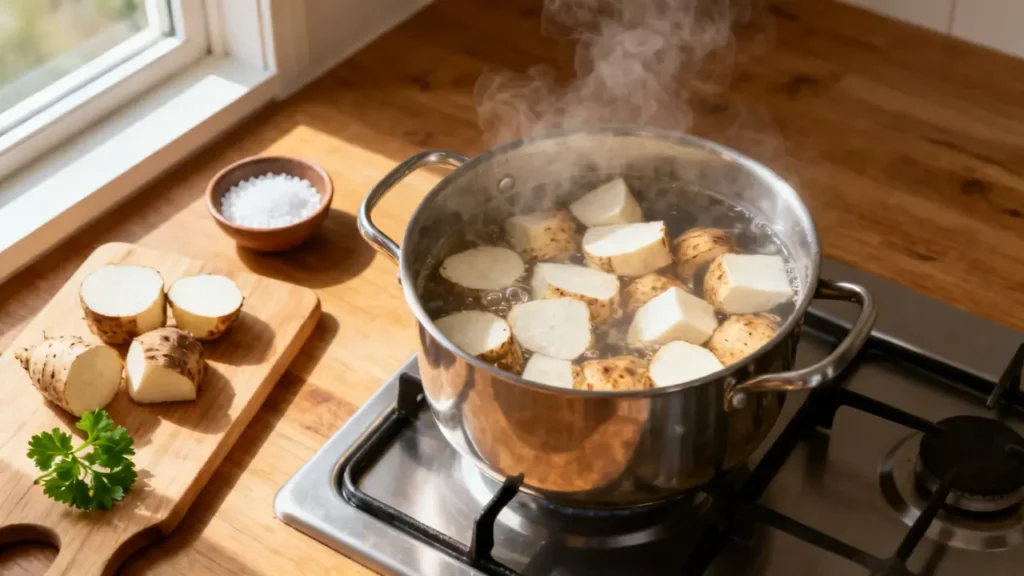

Quick answer — how long to boil malanga
Boil malanga until fork-tender: 1-inch cubes: 12–18 minutes, 2-inch chunks: 18–25 minutes, a medium whole tuber (6–10 oz): 25–35 minutes, and a large tuber (>12 oz): 35–50 minutes. In an Instant Pot, 1-inch cubes: 5–8 minutes high pressure (quick release) and a medium whole tuber: 12–15 minutes high pressure with a 5–10 minute natural release. Always test with a fork — the center should be uniformly tender.
Safety first: malanga contains calcium oxalate crystals that irritate skin and mouths if undercooked, so always cook until fully tender and wear gloves if your skin is sensitive.
What is malanga?
Malanga is a starchy tropical root also called yautia, tania, or cocoyam, related to taro. It has a dense, slightly nutty flesh that mashes smoothly and stands in for potatoes or yuca in many Caribbean and Latin American dishes. Use it boiled, mashed, fried, or in soups for a creamy, satisfying texture.
Safety first — why you must cook malanga fully
Malanga contains calcium oxalate crystals that can cause itching, burning, or irritation if the root is raw or undercooked. Fully cooking the root breaks down those crystals and makes the tuber safe to eat; never taste raw malanga to check doneness.
When peeling, wear gloves if you have sensitive skin and rinse the tuber to remove dirt. If someone in your household reports mouth itch after a first bite, cook the remaining pieces a bit longer; persistent irritation means discard and avoid raw handling next time.
How to prep malanga for boiling
Prep starts by trimming the ends, rinsing well, and removing the skin with a vegetable peeler or knife; the skin is fibrous and should be taken off before cooking. Wear gloves while peeling if your hands react to other root vegetables — the sap can irritate.
How to peel
Cut off both ends, slice a shallow lengthwise score, then slide a sturdy peeler or paring knife under the skin and remove in strips. For thick ends or knobby areas, use the knife to shave the skin away. Rinse peeled pieces to remove any remaining grit.
Should you soak or rinse?
Rinse to remove dirt; soaking isn’t necessary and won’t speed cooking. If pieces brown while prepping, keep them in cold water with a splash of lemon or vinegar to stop oxidation for up to an hour.
Cut sizes and why they matter
Smaller pieces cook faster because heat reaches the center sooner; large whole tubers need much more time. For even cooking, try to cut chunks uniform in size — we prefer 1-inch cubes for mashing and 2-inch chunks for sides.
Exact boiling times — stovetop
Use size-based timing rather than a single broad range: 1-inch cubes: 12–18 minutes, 2-inch chunks: 18–25 minutes, medium whole tuber (6–10 oz): 25–35 minutes, and large whole tuber (>12 oz): 35–50 minutes. Start timing when the water returns to a gentle simmer after adding the malanga.
Test doneness by inserting a fork into the center — it should slide in without resistance and the core must not be gritty or chalky. If the fork meets resistance, continue simmering and check every 5 minutes.
- 1-inch cubes: 12–18 minutes (fork-tender)
- 2-inch chunks: 18–25 minutes
- Medium whole tuber (6–10 oz): 25–35 minutes
- Large whole tuber (>12 oz): 35–50 minutes
- Baby/small tubers: 15–20 minutes
How to boil malanga — stovetop step-by-step
Place peeled and cut malanga in a pot and cover with cold water by about 1 inch; add roughly 1 teaspoon kosher salt per quart of water. Bring to a boil, reduce to a simmer, cover, and start timing from the return to a simmer to avoid overcooking the exterior.
Maintain a gentle simmer — a hard rolling boil can break the pieces apart and make them waterlogged. Drain promptly when fork-tender and finish as desired: mash, fry, or use in soups.
- Trim and peel the malanga; cut into uniform pieces.
- Put pieces in a pot, cover with cold water by 1″ and add salt (1 tsp kosher salt per quart).
- Bring to a boil, reduce to a simmer, cover, and time by cut size.
- Check with a fork; drain immediately when tender.
Boiling alternatives & quick methods
Pressure cooking and microwaving speed things up when you need malanga fast. Follow manufacturer minimum liquid guidelines for pressure cookers (Instant Pot requires at least 1 cup), and use the size-based timing below as your guide.
Instant Pot / pressure cooker
For 1-inch cubes, cook on high pressure for 5–8 minutes and use quick release. For a medium whole tuber, cook on high pressure for 12–15 minutes and allow a 5–10 minute natural release to finish cooking gently. Always use at least 1 cup of liquid and follow your cooker’s minimum liquid rules.
Microwave steaming
Place 1-inch cubes in a covered microwave-safe dish with a splash of water and microwave on high for about 6–8 minutes, stirring halfway. Cooking time varies by microwave wattage; check at 6 minutes and add 1–2 minute increments until fork-tender.
Roasting alternative
If you want a drier, slightly caramelized texture, roast 1–2-inch chunks at 400°F (200°C) for 35–45 minutes, tossing once halfway. Roasting gives a firmer bite and works well for bowls or salads when you don’t want a mashed finish.
For more pressure-cooker tips see our guide to how to boil in Instant Pot, and for similar roots try our notes on how to boil yuca and how to boil taro.
Finishing, troubleshooting & storage
Once boiled, malanga can be mashed, pan-fried into fritters, or added to soups. For mashing, aim for roughly per 1 lb malanga: 2–3 Tbsp butter and 1/4–1/3 cup milk or cream, adjusting to texture and taste. Season with salt, pepper, and optional garlic or cilantro.
Simple mashed malanga
Cook and drain 1 lb peeled malanga, mash with 2–3 Tbsp butter, 1/4–1/3 cup milk, and salt to taste. Add roasted garlic or a splash of lime for brightness; the finished mash should be creamy, not gluey.
We’ve linked a few recipe ideas — and if you’re comparing techniques, see our Instant Pot notes and the guide on boiling potatoes in the Instant Pot: how to boil potatoes in Instant Pot — similar timing strategies apply.
Troubleshooting common problems
If malanga is undercooked, cut into smaller pieces and simmer or pressure-cook an extra 5–10 minutes. If it turns gummy, you’ve likely overcooked or waterlogged it — drain, warm through with hot milk and butter when mashing to help revive texture. If you notice mouth or skin itch, re-cook thoroughly and wear gloves next time.
I learned the hard way that crowding the pot with uneven sizes leaves some pieces undercooked; I now cut more uniformly and stagger cooking times, which saves re-boiling later. Daniel swears the fork-test is the only reliable final check.
Storage & reheating
Cool boiled malanga to room temperature then refrigerate up to 3–4 days or freeze portions (mashed or chunks) up to 3 months. Reheat gently on the stove with a splash of water or milk, or microwave covered, stirring to restore creaminess.
Quick-reference timing summary
For a one-screen answer: 1-inch cubes 12–18 min; 2-inch chunks 18–25 min; medium whole tuber 25–35 min; large tuber 35–50 min. Instant Pot: 1-inch cubes 5–8 min high pressure; medium whole tuber 12–15 min high pressure + 5–10 min NR.
- Start timing from the return to simmer (stovetop) or from full pressure (Instant Pot).
- Always test with a fork — center must be tender with no chalky core.
- Add 1 tsp kosher salt per quart of cooking water for seasoning.


