
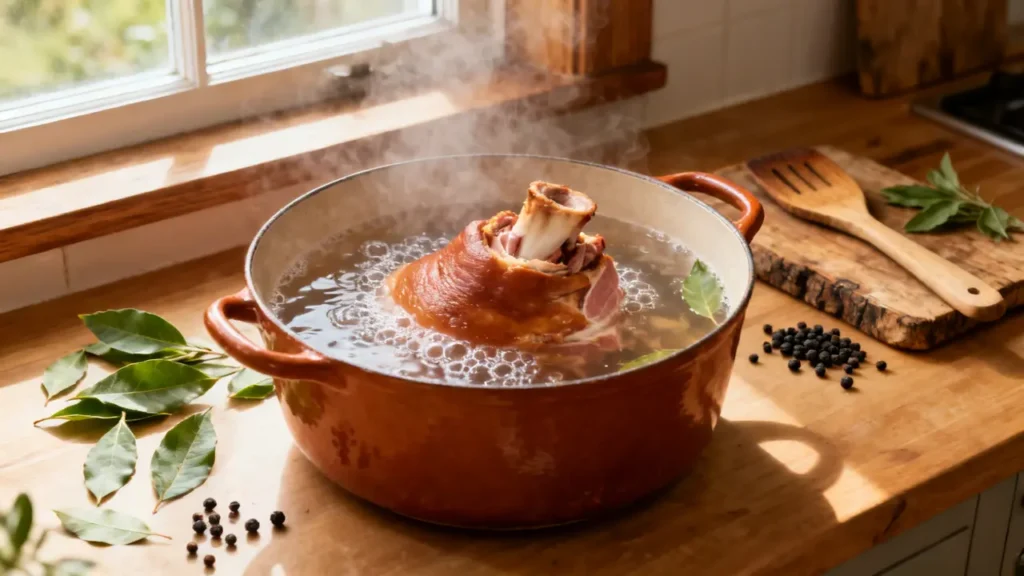

We’ll tell you exactly how long to boil smoked ham hocks — times by size and method, the temperature targets to reach shreddable meat, and smart tricks to cut salt and keep your broth clear. You’ll get stovetop ranges by ham-hock weight, exact Instant Pot and slow-cooker timings, and a short cheat-sheet to follow at the stove.
Do you need to boil smoked ham hocks?
Yes — boiling (technically simmering) is the most reliable way to extract smoky flavor, render collagen, and tenderize the tough connective tissue in ham hocks so they enrich soups, beans, and greens. Simmering extracts flavor while breaking collagen into gelatin, which gives rich mouthfeel to broth and keeps meats moist.
You can roast or braise hocks for a different texture and deeper crust, but for most home recipes — split pea, collards, or beans — simmering or slow-cooking is the easy, flavorful choice. If you want stock and shreddable meat, go the simmer route and follow the time/temperature guidance below.
How Long to Boil Smoked Ham Hocks — Quick Reference
Stovetop simmer times vary with ham-hock size: small (≤0.5 lb) becomes tender in about 45–60 minutes, medium (0.6–1.2 lb) in 1.5–2 hours, and large (>1.2 lb) in 2–3 hours. For shreddable meat aim for a target of 190–203°F (88–95°C) or a firm fork-test where the meat easily pulls from the bone.
Pressure-cooker and slow-cooker times compress the ranges: Instant Pot on high pressure usually needs 25–35 minutes for medium hocks and 30–45 minutes for large, plus a 10–15 minute natural pressure release. Slow cooker is hands-off: 6–8 hours on Low or 3–4 hours on High.
Keep hocks covered by about 1–2 inches of liquid and simmer gently — a gentle surface movement at about 185–205°F (85–96°C) — rather than a rolling boil which can toughen meat and make broth cloudy.
- Small (≤0.5 lb): 45–60 minutes stovetop
- Medium (0.6–1.2 lb): 1.5–2 hours stovetop; 25–35 min Instant Pot
- Large (>1.2 lb): 2–3 hours stovetop; 30–45 min Instant Pot
- Slow cooker: 6–8 hrs Low / 3–4 hrs High
Exact temperatures and why they matter
Food safety for pork lists a minimum of 145°F (63°C) for whole-muscle cuts, but ham hocks are full of collagen and connective tissue; to render that gelatin you want the meat to reach about 190–203°F (88–95°C). At those temperatures collagen dissolves and the meat becomes shreddable and silky instead of tough.
Maintain a gentle simmer around 185–205°F (85–96°C). Vigorous rolling boils agitate proteins and fats, producing a cloudy broth and a firmer, stringy texture. Use an instant-read thermometer on a piece of meat if you’re uncertain — texture (fork-test) plus temperature gives the best cue.
Step-by-step stovetop method (best practice)
Start by rinsing the hocks, trimming any loose fat if you like, and placing them in a pot cold water just to cover. Starting from cold lets connective tissue and smoky flavor extract evenly into the liquid. Add aromatics now (onion, garlic, bay leaf, 10–12 peppercorns) and bring slowly to a gentle simmer.
Prep: rinse, trim, optional soak
If your hocks look very salty on the surface, rinse under cold water. For extremely salty hocks you can parboil 10–15 minutes and discard that water, then refill with fresh water and simmer to finish — this pulls out surface salt without stripping all smoky flavor.
Bring up and simmer (not boil)
Heat the pot so it comes to the simmer slowly, then lower heat to maintain small bubbles and gentle movement. Skim any gray foam from the surface in the first 15–20 minutes — this improves clarity. Keep liquid covering the hocks by about 1–2 inches.
How to tell when smoked ham hocks are done
Use a fork-test and temperature: meat should pull away from the bone easily and the connective tissue should feel soft. If you want a number, aim for 190–203°F (88–95°C) internal; the fork will slide in and the meat will shred with little resistance. Stop cooking when you have the texture you need — for soups you may want meat that still holds together, for shredded uses go longer.
I learned the hard way that simmer time is not the same every time — one week a medium hock needed only 90 minutes, another batch needed almost 2 hours because the hocks were thicker and smoked differently. Trust the fork-test and temperature more than the clock.
When done, lift hocks from the pot, let cool slightly, remove meat from bone, strain broth through a fine sieve, and chill to let fat rise so you can skim it off. Store meat and broth separately for best shelf-life.
Salt control, pressure cooker & slow cooker tips
Smoked ham hocks can be high in sodium — if salt is a concern, rinse or parboil for 10–15 minutes and discard the water, then cook in fresh liquid. Avoid adding extra salt until you taste the finished broth, since hocks already season the dish well.
Pressure cooker (Instant Pot) method
Place hocks and aromatics in the Instant Pot with at least 1–1.5 cups of liquid (follow your model’s min-liquid rule) and seal. Cook on high pressure for 25–35 minutes for medium or 30–45 minutes for large, then use a 10–15 minute natural release to finish collagen breakdown.
Slow cooker method
Low and slow gives the most forgiving texture: cook on Low for 6–8 hours or High for 3–4 hours, keeping hocks submerged. The meat will be very tender and the broth richly flavored; just be mindful of sodium and add extra salt only at the end.
For pressure-cooker and slow-cooker resources and variations, see our guide to boiling in the Instant Pot.
Common mistakes and troubleshooting
Too cloudy a broth usually means a boil or too-rapid agitation; fix it next time by simmering gently and skimming early foam. If the meat is rubbery, it’s undercooked — continue to simmer until the fork-test passes or the interior reaches 190–203°F. If it’s falling apart too much, you’ve likely gone past the texture you need for that recipe; remove hocks earlier next time.
Overly salty broth can be diluted with water or unsalted stock; adding a peeled potato while simmering to absorb salt is a kitchen myth — it won’t remove a meaningful amount of sodium, so rely on rinsing/parboiling and dilution instead. For tips on reducing excess salt see our short how-to on parboiling ham to remove salt.
If your goal is to cook greens with ham hocks, add the hocks early for flavor and finish the greens to the tenderness you like; for a deeper dive, check our collards guide at how to boil collard greens.
Food safety, storage, and quick uses
Cool leftovers within 2 hours, refrigerate for 3–4 days, or freeze both broth and meat for up to 3 months. Reheat to a simmer or to an internal temperature of at least 165°F (74°C) before serving.
Reuse strained ham-hock broth for soups, beans, or to braise greens. It’s especially good with split pea soup, pinto beans, and collards; and if you want a ham-bone-style stock, see our article on how to boil a ham bone for stock for step-by-step storage tips.
Quick cheat sheet
For a fast reference: stovetop times depend on size, pressure-cooker times are about a third of stovetop, and slow cooker is hands-off but takes hours. Always use a fork-test and when making shredded meat target 190–203°F (88–95°C).
- Stovetop: Small 45–60 min, Medium 1.5–2 hrs, Large 2–3 hrs
- Instant Pot: Medium 25–35 min, Large 30–45 min + 10–15 min natural release
- Slow cooker: 6–8 hrs Low or 3–4 hrs High
- Salt fix: Rinse or parboil 10–15 min, then cook fresh
And don’t forget: how long to boil smoked ham hocks is a useful starting point, but texture and temperature are the final authority — check the fork and feel the difference.


