
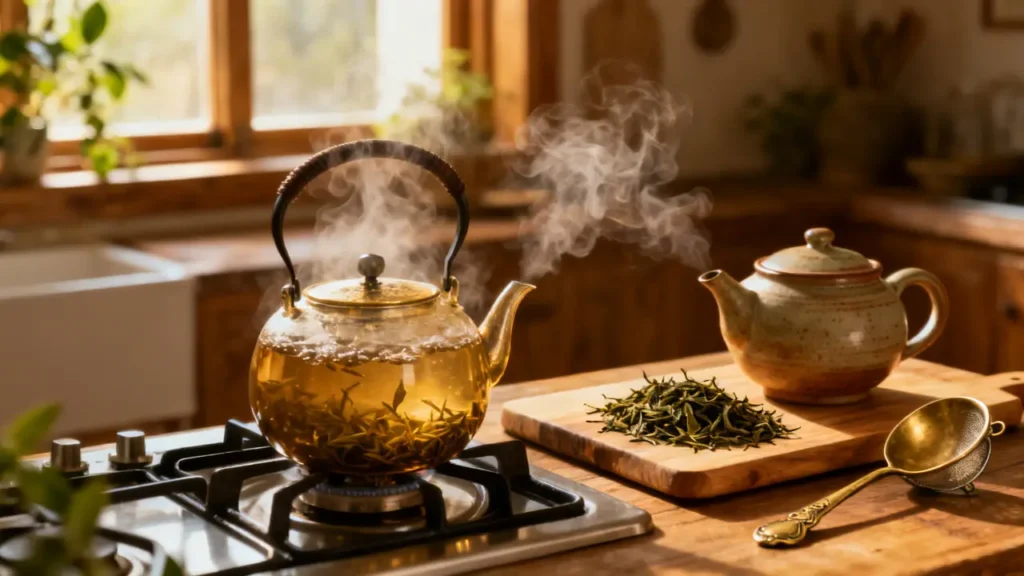

Quick answer: How long to boil tea on the stove
The short answer: bring water to the tea-specific temperature — not always a full boil. On a typical home stove, heating 1 cup (8 oz / 240 ml) to boiling takes about 3–5 minutes on medium-high with a lid, while larger volumes scale to 2 cups ≈ 5–7 minutes and 1 liter ≈ 8–12 minutes. Steeping is separate: black/herbal at 212°F / 100°C for 3–7 minutes, green/white at 160–185°F / 71–85°C for 1–4 minutes, oolong at 185–205°F / 85–96°C for 3–5 minutes.
Below we cover exact stove settings, bubble-stage visual cues for people without thermometers, altitude tweaks, a stovetop chai simmer method, loose-leaf ratios, reboiling guidance, and quick fixes for bitter, weak, or cloudy tea.
Boiling vs heating: What you actually need for different teas
Many people confuse boiling the water (bringing it to 212°F / 100°C) with the temperature you need to steep a delicate tea. For full-bodied black and herbal teas you want a rolling boil at 212°F / 100°C, but for green, white, and some oolong teas you should stop heating earlier and steep at lower temperatures to avoid bitterness. Think of two steps: heat to temperature, then steep for the tea’s recommended time.
Why it matters: higher temps extract more tannins and bitterness quickly, which is perfect for robust blacks but harsh for greens. A thermometer helps, but we also give visual bubble cues later so you can nail temperatures without extra tools.
Stovetop timing — how long to heat water by volume (practical guide)
Heating time depends on volume, pot material, lid use, and stove power. For a typical home gas or electric stove using a medium-weight saucepan, expect 1 cup (8 oz/240 ml): 3–5 minutes with lid, 4–7 minutes without; 2 cups: 5–7 minutes with lid; 1 liter (34 oz / ~4 cups): 8–12 minutes with lid. Use these as conservative ranges — powerful burners are faster, older electric coils are slower.
Typical times for one cup (8 oz / 240 ml)
Answer: on medium-high heat with a lid, bring 1 cup of cold tap water to a rolling boil in about 3–5 minutes. Without a lid expect 4–7 minutes. For green/white tea you often stop heating earlier — see visual cues to know when you’ve hit 160–185°F / 71–85°C.
Practical stove note: set gas burners to medium-high (flame about 1–1.5 inches under pot), and electric to a setting you know brings water to boil in the above ranges — if your burner dial is 1–10, that’s usually 7–8 for medium-high.
Times for larger quantities (2 cups, 1 liter / quart)
Answer: heating scales roughly with volume and pot surface area. Two cups usually take 5–7 minutes with a lid on medium-high; 1 liter takes 8–12 minutes. Using a lid cuts heat loss and reduces time by roughly 25–40%, while a wide shallow pan heats faster than a tall narrow one.
Speed tips: lid, cold vs warm pot, kettle vs saucepan
Answer: always use a lid to save time, start with cold water (hot from tap has minerals but is okay in a pinch), and pre-warming the pot with hot tap water shaves a minute or two. A dedicated kettle (especially electric) will usually be faster and more efficient than a saucepan on low-power burners.
Target water temperatures for each tea type
Answer: each tea needs a target temperature to extract the best flavors. Use these ranges and steep times: black/herbal 212°F / 100°C, oolong 185–205°F / 85–96°C, green 160–185°F / 71–85°C, white 175–185°F / 79–85°C, pu-erh often near boiling. If you want a quick visual table, see below.
Table (printable) — temperatures in °F / °C and recommended steep times:
| Tea | Temp | Steep |
|---|---|---|
| Black / Herbal | 212°F / 100°C | 3–5 min (black), 5–7+ min (herbal) |
| Oolong | 185–205°F / 85–96°C | 3–5 min (multiple infusions shorter) |
| Green | 160–185°F / 71–85°C | 1–3 min |
| White | 175–185°F / 79–85°C | 2–4 min |
| Pu-erh | 195–212°F / 90–100°C | Rinse, then 10–30s increments (gongfu) |
Visual cues if you don’t have a thermometer: small sticky bubbles on the pot bottom = ~160–175°F; larger rising bubbles that break at the surface = ~180–190°F; a rolling boil with vigorous motion = 212°F. Watching bubble stages is a reliable way to stop heating at the right moment.
How long to steep each tea (exact times + tips)
Answer: steep times are short and precise — over-steeping is the most common mistake. For black use 3–5 minutes, green 1–3 minutes, white 2–4 minutes, oolong 3–5 minutes (or shorter multiple infusions), and herbal 5–7+ minutes. Use a timer — seconds matter with delicate greens.
Black & herbal
Answer: steep black tea in boiling water (212°F / 100°C) for 3–5 minutes depending on strength. For herbal tisanes leave them longer — 5–7+ minutes — because they’re caffeine-free and benefit from more extraction. Use 1 teabag or 1 tsp (2–3 g) loose leaf per 8 oz as a starting point and adjust.
Green & white
Answer: use lower temps — 160–185°F / 71–85°C — and short steeps: 1–3 minutes for green and 2–4 minutes for white. If you only have boiling water, pour it out for 30–45 seconds or decant into a cooler cup to drop temperature, or watch for the small-bubble stage when heating.
Oolong & pu-erh
Answer: oolong benefits from multiple infusions at 185–205°F / 85–96°C; start with 30–90 seconds for gongfu-style and add time for later infusions. Pu-erh often uses near-boiling water and can be rinsed first; then brew in short bursts and increase time by 10–30 seconds each infusion.
Iced tea
Answer: for hot-brew iced tea bring water to the appropriate temp and steep at the high end of the range for slightly stronger brew (e.g., black 4–5 minutes), then chill. Cold-brew tea is gentler: steep in cold water in the fridge for 6–12 hours depending on strength desired.
Stovetop milk tea and chai — when to boil and how long to simmer
Answer: milk tea and masala chai are brewed differently — you simmer spices in water, add tea briefly, then add milk and simmer gently to marry flavors without scalding. For a typical stovetop chai simmer spices 3–5 minutes, add tea and steep 1–2 minutes, then add milk and simmer another 3–5 minutes on medium-low.
Stovetop Chai — simmer method (quick recipe)- Combine 1 cup water, 1–2 smashed cardamom pods, 1 small cinnamon stick, 2 thin slices ginger, 1–2 cloves; simmer on medium-low for 3–5 minutes.
- Add 1 tsp black tea (or 1 teabag) and steep 1–2 minutes.
- Add 1 cup milk, bring to gentle simmer (do not boil over), simmer 3–5 minutes, strain and sweeten to taste.
Tip: adding tea to spices in water first prevents tannins from over-extracting in milk. If you want our tested masala proportions and full stovetop recipe, see our Masala chai recipe: stovetop method.
Measurements, equipment, reboiling, altitude & common mistakes
Answer: use 1 tsp (2–3 g) loose leaf per 8 oz / 240 ml for most teas, increase to 1.25–1.5 tsp for stronger black or oolong; teabags are generally one bag per cup. Recommended equipment: an instant-read thermometer, mesh infuser, and a gooseneck kettle if you pour for pour-over precision. See our product guide for kettles and tools here.
Reboiling: reboiling water once is safe but can taste flat because oxygen levels drop and minerals concentrate; for best flavor use fresh cold water when practical. Altitude: boiling point falls about 1°F (≈0.5°C) per 500 ft (≈150 m); at 5,000 ft the boiling point is ≈ 203°F / 95°C. If you’re high-altitude, either steep a little longer or use slightly more leaf to compensate.
Common mistakes and fixes: oversteeping (fix: use a timer and decant immediately), boiling delicate greens (fix: watch bubble stages or cool boiled water 30–45 seconds), too little leaf (fix: add 1/4–1/2 tsp more per cup), and hard water (fix: use filtered water or a pinch of baking soda for very hard water to cut cloudiness).
For precise green-tea technique and cooling methods, check our in-depth guide How to brew the perfect green tea, and for measuring loose leaf properly see How to measure loose-leaf tea. We also cover why filtered water matters in Water quality for coffee & tea.
Troubleshooting: My tea is bitter/weak/cloudy — what to do
Answer: bitterness usually means too-hot water or too-long steeping; use lower temp and shorter steep for delicate teas. Weak tea generally means too little leaf or too short a steep; add more leaf or steep to the longer side of the range. Cloudy tea often comes from hard water — try filtered water or a paper-filter pour to clarify.
Quick checks: if bitter, cool the water for greens or decant into a second pot; if weak, increase to 1.25 tsp loose leaf per cup or steep an extra 30–60 seconds; if cloudy, use filtered/softened water or add a dash of lemon to clear mineral cloudiness in some herbals.
Quick reference cheat sheet
Answer: here’s a printable one-line cheat for common teas: Black/Herbal — 212°F / 100°C, 3–7 min; Oolong — 185–205°F / 85–96°C, 3–5 min; Green — 160–185°F / 71–85°C, 1–3 min; White — 175–185°F / 79–85°C, 2–4 min; Pu-erh — rinse, then short infusions at near boiling.
- 1 cup to boil (lid): 3–5 min
- 2 cups: 5–7 min
- 1 L: 8–12 min
- Loose leaf ratio: 1 tsp (2–3 g) per cup
Pro tip: Sarah learned the hard way that crowding the teapot with too many leaves produces bitter tea — we now weigh leaves for special teas. I (Daniel) once brewed a delicate sencha with boiling water by accident; a quick decant and shorter second steep saved the cup and taught me to use the small-bubble cue every time.


