
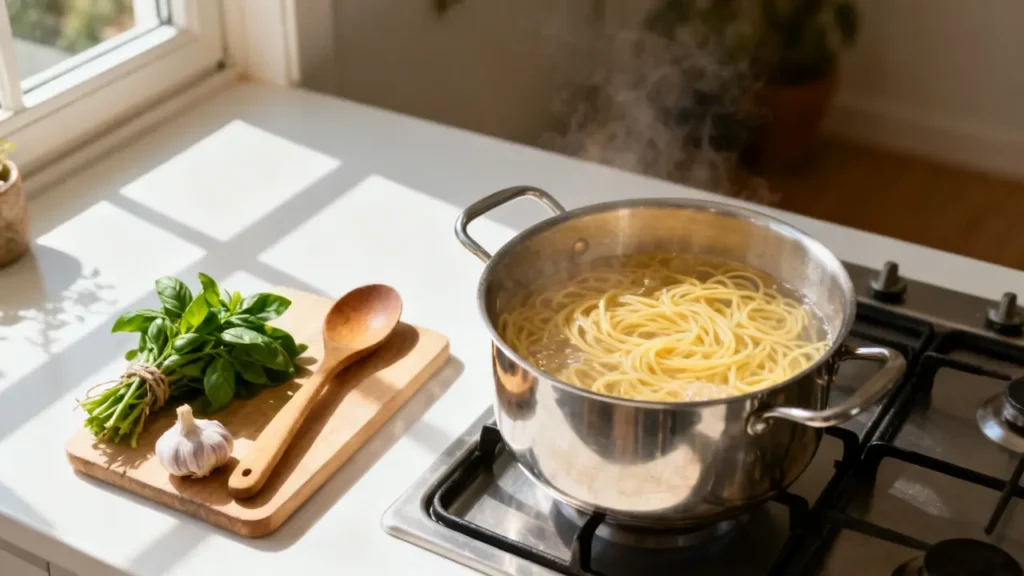

If you want a fast, reliable answer to how long to boil thin spaghetti, here it is: for dried thin spaghetti (spaghettini) boil in vigorously boiling, well‑salted water for 6–8 minutes for al dente to tender; fresh thin spaghetti cooks in 1–3 minutes. Keep the water rolling, stir early, and reserve ½–1 cup (120–240 ml) of starchy pasta water for the sauce. The bite test is your best friend—always taste before you drain.
Quick answer
The short answer to “how long to boil thin spaghetti” is: 6–8 minutes for dried spaghettini at sea level (start testing at 4–5 minutes), and 1–3 minutes for fresh. Use a large pot, bring water to a rolling boil (about 100°C / 212°F at sea level), salt the water until it tastes like the sea, and stir in the first minute to prevent clumping. If you’re finishing the pasta in sauce, pull it out 30–60 seconds early to allow for carryover cooking while you toss it with reserved pasta water.
What is thin spaghetti?
Thin spaghetti—commonly sold as spaghettini—is slimmer than standard spaghetti, usually around 1.3–1.7 mm in diameter, which is why it cooks faster: less thickness means heat reaches the center quicker. The thinner the strand, the less time you need to reach al dente; that’s also why package times for spaghettini are shorter than regular spaghetti. Choosing the right type (thin dried vs fresh) changes both texture and cooking strategy.
Spaghettini vs spaghetti vs bucatini
Spaghettini is a light, delicate strand—think long, thin threads—while regular spaghetti is thicker and takes longer to cook. Bucatini is thicker still and has a hollow center, so it needs more time and a heartier sauce. Because of those thickness differences, always adjust cooking time: spaghettini 6–8 minutes dried, spaghetti often 8–11 minutes, and bucatini longer.
Dried vs fresh thin spaghetti
Dried thin spaghetti is denser and needs a few minutes to rehydrate and cook through; fresh thin spaghetti is already hydrated and cooks in 1–3 minutes. Fresh pasta’s texture is softer and more fragile, so test early—start at 1 minute and taste every 30 seconds. If you’re using fresh pasta, check our notes on finishing in the pan so it doesn’t go from perfect to mush in seconds (see our guide on fresh spaghetti).
Exact timing guide (at sea level)
Use these recommended ranges as a starting point: for dried thin spaghetti aim for 6 minutes for reliably al dente and 8 minutes for tender; for fresh thin spaghetti aim for 1–3 minutes and test at 1 minute. Begin testing earlier if the package lists shorter times, and always trust the bite test rather than the clock alone. Remember that carryover cooking adds roughly 30–120 seconds after you drain or when you finish in a hot pan.
Dried thin spaghetti (recommended)
For most brands of dried spaghettini, we recommend 6–8 minutes at sea level for al dente to tender. Start tasting at about 4–5 minutes if the package lists shorter times, and look for a firm bite with a tiny white core in the center for true al dente. If you plan to finish the pasta in sauce, remove the strands about 30–60 seconds before your target doneness and finish cooking them in the sauce with reserved pasta water.
Fresh thin spaghetti
Fresh thin spaghetti usually cooks in 1–3 minutes; test at 1 minute, then every 30 seconds. Fresh strands go from perfectly chewy to overcooked very quickly, so keep a close eye and toss immediately into sauce or a gentle drizzle of olive oil if serving plain. If you want step-by-step timing for fresh versus dried, see our internal note on how to boil pasta for al dente.
- Dried spaghettini: 6 min (al dente) — 8 min (tender)
- Fresh spaghettini: 1–3 min (test at 1 min)
Step-by-step: How to boil thin spaghetti perfectly
What you need (equipment & quantities)
Use a large pot (at least 5–6 quart / 4.7–5.7 L for a pound of pasta) to avoid crowding; a colander, a timer, and a ladle to scoop starchy water are essential. Aim for about 4–6 quarts (3.8–5.7 L) of water per 1 lb (450 g) pasta, or a simple metric: 1 L per 100 g pasta. For salt, use 1–2 tablespoons kosher salt per 4–6 quarts (about 1–1.5 tsp table salt per liter) — the water should taste like the sea.
Step 1 — Bring water to a rolling boil (temperature)
Bring the water to a vigorous, rolling boil—about 100°C / 212°F at sea level—before adding pasta; a weak simmer will make pasta gummy and extend cook time. Keep the heat high so the water returns to a boil quickly after you add the pasta. At high altitudes the boiling point drops, so expect slightly longer cooking and rely on taste (see Special Situations).
Step 2 — Salt the water (how much and why)
Add salt once the water is boiling and you can tell it dissolves quickly—about 1–2 tbsp kosher salt per 4–6 quarts. Salting flavors the pasta itself; it won’t make the water boil faster. Taste a spoonful of the water: it should be noticeably salty (like seawater) but not overpowering.
Step 3 — Add pasta and stir (when and how often)
Add the thin spaghetti and immediately stir for 10–15 seconds to separate strands, then stir again within the first 30–60 seconds. Continue stirring occasionally during the first 2–3 minutes to prevent sticking; after that stir as needed. Avoid adding oil to the water—oil coats pasta and prevents sauce from clinging.
Step 4 — Test for doneness (bite test + visual)
Start tasting early: for dried thin spaghetti begin testing at 4–5 minutes, for fresh at 1 minute. Al dente should be tender but still with a slight chew and — for dried pasta — a barely visible white dot in the center when bitten. If you’re finishing in sauce, remove the pasta when it’s slightly under your ideal and finish it in the pan with sauce and reserved pasta water.
Step 5 — Drain and finish (reserve pasta water, finish in sauce)
Reserve ½–1 cup (120–240 ml) of starchy pasta water before draining; this helps emulsify sauces and bind them to the pasta. If finishing in sauce, toss pasta into the pan with sauce over medium heat and add small splashes of pasta water until the sauce clings. Let it cook in sauce for 30–60 seconds so carryover cooking and sauce melding can finish the job.
Common problems and troubleshooting
Sticky or clumped pasta — prevention and fixes
Sticky or clumped pasta usually means too little water, not enough stirring, or overcrowding the pot. Prevent this with 1 L per 100 g pasta, a vigorous boil, and an early stir; never rely on oil in the water. If the pasta clumps right after draining, plunge it briefly into the pot of boiling water, stir gently, then drain again—or toss immediately with sauce and a splash of reserved pasta water to separate strands.
I learned the hard way that stuffing a pound of spaghettini into a small pot ends in gluey noodles—now I always use at least 1 liter of water per 100 g and a big pot. That simple change eliminated most sticking problems in our weeknight tests.
Overcooked pasta — rescue tips
Slightly overcooked pasta can be disguised by finishing it in a robust sauce and sautéing briefly to evaporate excess moisture; the sauce will help mask softness. For very overcooked pasta consider turning it into a baked pasta casserole or a salad where textures are less critical. Rinsing won’t restore firmness—only stronger sauces and baking can help.
Undercooked pasta — quick finishes
If pasta is undercooked, finish it in a skillet with sauce and a splash of pasta water, covered for a minute or two, or return it to rapidly boiling water for 30–60 seconds. Always taste after 30 seconds to avoid overshooting. If you drained already, tossing in hot sauce is usually the fastest rescue.
Special situations
Cooking pasta at high altitude
At high altitude water boils at a lower temperature so pasta will take longer to reach the same doneness—add roughly 1–2 minutes to the recommended time for dried thin spaghetti and test frequently. Don’t increase the heat to force higher temperature; rely on the bite test and visual cues instead. Finishing in sauce helps control texture when the boiling point is lower.
Large batches / small pots — avoiding overcrowding
Overcrowding drops the water temperature and makes noodles clump; scale water up so you still have roughly 1 L per 100 g pasta and use multiple pots if needed. If you must use a smaller pot, cook in batches and combine in the sauce at the end. Stir more often for crowded pots to keep strands separate.
Making pasta for salads (cooling and texture tips)
For pasta salads cook thin spaghetti to just past al dente—about 30–60 seconds more than your al dente target—then shock in an ice bath to stop cooking and set the texture. Toss with a little oil to prevent sticking and chill. Rinsing is fine here because the pasta won’t be sauced hot.
Quick reference printable checklist
Here’s a short, actionable checklist to keep near the stove so you can follow along while cooking.
- Fill a large pot: 1 L water per 100 g pasta (or 4–6 qt per lb).
- Bring to a rolling boil (~100°C / 212°F), add 1–2 tbsp kosher salt per 4–6 qt.
- Add pasta, stir immediately, then again within 30–60 sec.
- Cook dried spaghettini 6–8 min (test at 4–5); fresh 1–3 min (test at 1).
- Reserve ½–1 cup (120–240 ml) pasta water, drain, and finish in sauce for 30–60 sec if desired.


