
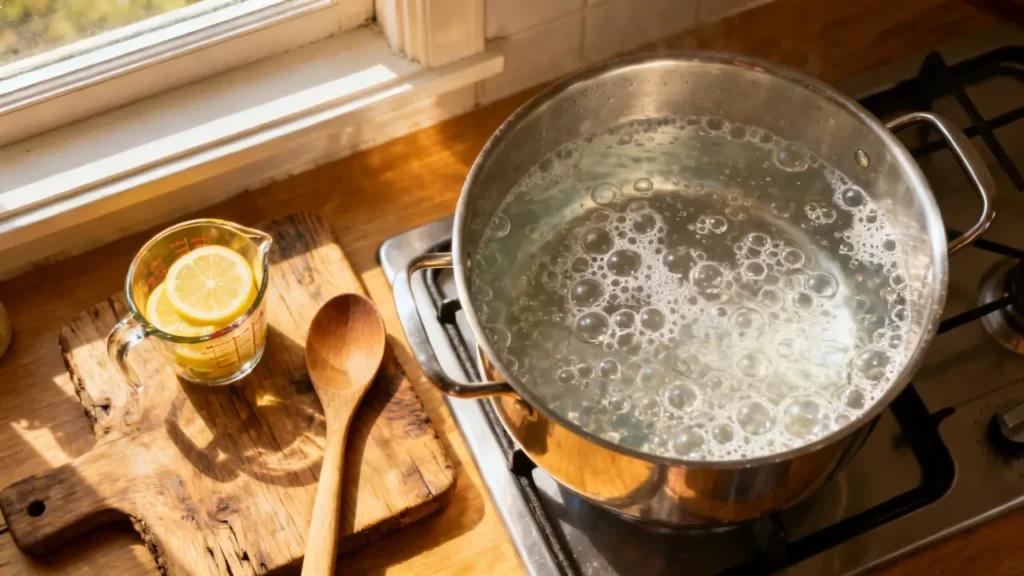

Quick answer — How long to boil water to remove chlorine?
You asked: how long to boil water to remove chlorine? The short answer is: for free chlorine, bring water to a rolling boil and boil uncovered for 1–5 minutes — 1 minute is enough for emergency disinfection, while ~5 minutes helps reduce taste and odor. If your water contains chloramine, boiling is unreliable and you should use an activated (preferably catalytic) carbon filter or a dechlorinating product instead.
This distinction matters because utilities use two different disinfectants. Knowing which one your water utility uses changes the method and time you should use to remove it. We’ll show simple tests, exact steps for different goals (drinking, cooking, aquarium), and the common mistakes people make.
Why chlorine (and chloramine) is used in tap water
Municipal water systems add disinfectants to kill harmful microbes; most commonly that’s free chlorine (as Cl2/HOCl) or chloramine (usually monochloramine, NH2Cl). Utilities pick chloramine sometimes because it stays active longer in distribution lines and forms fewer regulated disinfection byproducts.
People remove these chemicals for three reasons: taste/odor in drinking water, sensitivity (skin/eye issues), and aquatic life safety — fish and invertebrates are sensitive to both. We’ll focus on practical home solutions you can actually do: boiling, aeration, filters, or neutralizers.
Free chlorine vs. chloramine — why the difference matters
What is free chlorine?
Free chlorine in tap water exists as dissolved chlorine gas (Cl2), hypochlorous acid (HOCl), and hypochlorite (OCl−) depending on pH. These species are relatively volatile and will off‑gas when heated or aerated, so boiling or letting water stand will remove them fairly quickly.
That volatility is why a short rolling boil or vigorous aeration often eliminates the chlorine smell and taste. For emergency disinfection, CDC recommends bringing water to a rolling boil for 1 minute at sea level (increase to 3 minutes above 2,000 m / ~6,562 ft), which also removes free chlorine by off‑gassing.
What is chloramine?
Chloramine is a chemical combination of chlorine and ammonia (usually monochloramine). It’s far more stable, has a much lower vapor pressure, and does not off‑gas quickly. That makes it much harder to remove by boiling or simple aeration.
Because of that stability, utilities increasingly use chloramine to maintain residual disinfectant in long distribution systems. If your supplier uses chloramine, rely on activated carbon (preferably catalytic carbon), reverse osmosis, or a chemical neutralizer rather than counting on a pot on the stove.
Boiling to remove chlorine — practical guidance and exact times
How long to boil water to remove chlorine depends on what the utility uses and your goal (disinfection vs taste vs aquarium). For free chlorine, bring to a rolling boil and keep it boiling uncovered for 1–5 minutes: 1 minute for emergency microbial safety (CDC guidance), and up to ~5 minutes if your goal is to reduce taste and odor.
For chloramine, don’t rely on boiling: it may take 20–30+ minutes to significantly reduce levels and even then removal is unpredictable. Instead, use a carbon filter rated for chloramine (catalytic carbon) or a chemical dechlorinator suited to chloramine.
For free chlorine (taste & drinking)
Procedure we use at home: fill a pot, bring to a vigorous rolling boil, leave the pot uncovered and boil for about 3–5 minutes if taste is the issue, then cool uncovered so volatiles can vent and refrigerate in a covered container. For emergency disinfection follow the CDC rule: 1 minute at sea level (3 minutes if you’re above ~2,000 m).
For chloramine (don’t rely on boiling)
If your water uses chloramine, choose filtration or chemicals. A standard granular activated carbon (GAC) pitcher may help a little, but we recommend a catalytic carbon cartridge or reverse osmosis for reliable removal. Chemical dechlorinators made for aquariums (sodium thiosulfate‑based) neutralize chloramine quickly for fish, but check dosage labels.
- Quick reference: Free chlorine — boil uncovered 1–5 minutes. Chloramine — boiling unreliable; use catalytic carbon, RO, or dechlorinator.
Factors that change how fast chlorine comes out of water
Several physical variables affect off‑gassing: surface area, agitation/aeration, water temperature, whether the pot is covered, and altitude. More surface area and agitation (pouring between jugs, vigorous stirring) speeds volatilization, while a covered pot traps volatiles and slows removal.
Small volumes in a wide, shallow pan will lose chlorine faster than a full narrow kettle. Heating to a rolling boil helps, because hot water holds less dissolved gas; on the flip side, boiling reduces volume and concentrates any non‑volatile contaminants like nitrates or metals.
Step-by-step methods we’ve tested and recommend
Fast method for free chlorine (drinking/cooking)
Fill a clean pot with tap water and bring it to a vigorous rolling boil over high heat. Keep the pot uncovered and continue boiling for 1 minute for emergency disinfection or 3–5 minutes to noticeably reduce taste and odor. Turn off the heat, let the water cool uncovered until it no longer steams, then store in the fridge in a sealed container.
Aeration + cold method for taste (no boil)
If you’re avoiding boiling for convenience, pour water back and forth between two large pitchers or use a fountain aerator for 30–60 minutes; chill afterward. This increases surface area and lets chlorine off‑gas without concentrating non‑volatile contaminants. It works well for free chlorine but not for chloramine.
For fish tanks and sensitive uses
We never boil aquarium water to remove chloramine — it’s unreliable and stressful for livestock. Use a commercial dechlorinator (follow dosage) or an activated/catalytic carbon filter; for large tanks, pre‑treat water in buckets with the proper neutralizer. See our deeper guide on dechlorinating for aquariums in the linked resources below.
What boiling does NOT remove (and the risks)
Boiling removes microbes and volatile disinfectants, but it does not remove dissolved heavy metals (lead, copper), nitrates, or many chemical contaminants. In fact, boiling concentrates non‑volatile pollutants because water volume decreases through evaporation.
So if your water source could contain inorganic contaminants, don’t assume boiling makes it safer. For those concerns, use a certified point‑of‑use filter (RO or specific contaminant cartridge) or lab testing to confirm safety.
How to tell whether your water uses chlorine or chloramine (and what to do)
The easiest way is to check your local water utility’s annual consumer confidence report (CCR) or call them — they list disinfectants used. You can also use chlorine/chloramine test strips or kits; a free chlorine test will show near‑zero for chloramine but a total chlorine test will show a reading because chloramine counts as combined chlorine.
If you find your utility uses chloramine, switch to a solution designed for it: catalytic carbon filters, reverse osmosis, or chemical neutralizers. For boil advisory situations or distribution problems, check our related boil water advisory guide and the utility notices for exact safe‑boil times and instructions.
Daniel once boiled a big batch of water for cold brew because the tap tasted chlorinated. I (Sarah) let it cool covered on the counter — and the chlorine smell never fully left. That taught us to always cool uncovered for venting and to double‑check whether our utility was using chloramine before relying on boiling for taste.
Troubleshooting — still smell chlorine after boiling?
If boiled water still smells or tastes like chlorine, first confirm what disinfectant your water uses. Persistent odor after proper boiling usually indicates chloramine or other chemical contaminants that boiling won’t remove.
Try a carbon filter rated for chloramine, or use a test strip to check residual levels. If you’re preparing water for fish or sensitive brewing, use a dechlorinator designed for chloramine and follow the manufacturer’s dosing instructions.
Best methods by use-case (what we actually recommend)
For drinking and cooking where the utility uses free chlorine, boiling uncovered for 1–5 minutes is simple and effective. If taste is the only issue and you have time, aerate in a wide pitcher and chill overnight for a no‑heat option.
For drinking water when your utility uses chloramine, use a point‑of‑use system: a carbon block or catalytic carbon pitcher, or a reverse osmosis unit for the highest reliability. For aquariums, use a neutralizer specifically formulated for chloramine — it both detoxifies chlorine and breaks the chloramine bond safely for fish.
For emergencies (boil water advisories, water main breaks), follow your utility’s instructions and our related guide on what to do after a water main break. In general, boil 1 minute (sea level) or 3 minutes at high altitude to inactivate pathogens.
Quick buyer’s guide — filters & products that remove chlorine and chloramine
For free chlorine, a basic GAC (granular activated carbon) or carbon-block pitcher removes taste and odor well. For chloramine, look specifically for catalytic carbon or systems certified for chloramine reduction; standard GAC cartridges may only partially remove it.
Reverse osmosis removes both disinfectants and many other contaminants but at higher cost and with water waste. For aquariums, use aquarium dechlorinators (check label for chloramine compatibility) — they act quickly and are inexpensive for treating bucket loads of water.
Sources & further reading
Authoritative sources include the CDC’s boil water guidance (rolling boil for 1 minute at sea level; 3 minutes above ~2,000 m) and EPA materials on chlorination/chloramine. For product choices and aquarium chemistry, look for catalytic carbon specifications and manufacturer data.
Internal reading we recommend: our boil advisory guide, practical steps for purifying tap water, and deeper how‑to pieces on dechlorinating for fish tanks and choosing the right water filter. These will walk you through product picks and dosing for neutralizers.


