
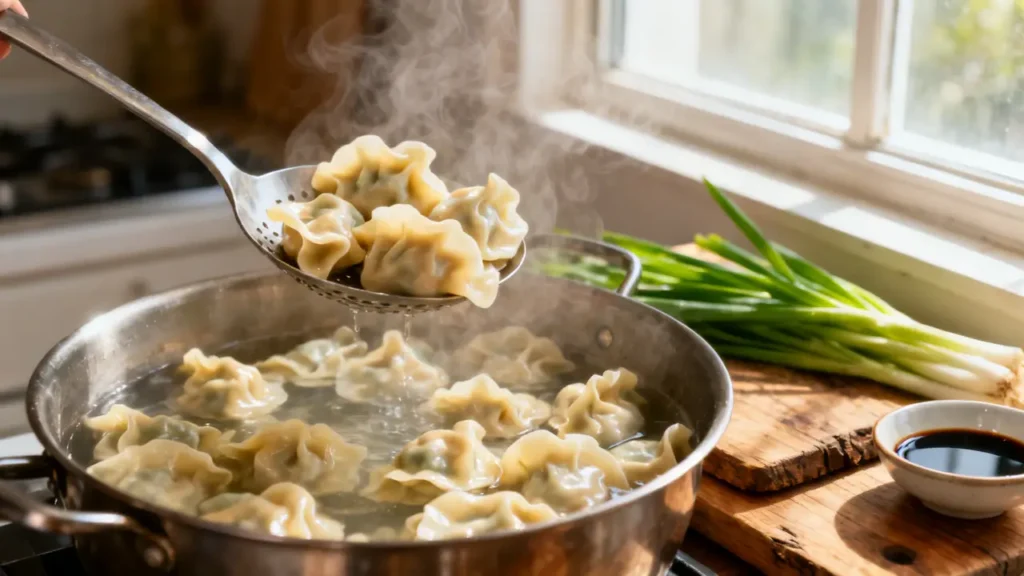

How long to boil wontons? Fresh wontons cook in 2-4 minutes after the water returns to a rolling boil, while frozen need about 6-8 minutes or until the filling reaches 165°F (74°C). Stir gently, cook in batches, and test one for doneness.
Quick answer: how long to boil wontons
For a quick rule, boil fresh wontons for 2-4 minutes and frozen wontons for 6-8 minutes, counting from the moment the water returns to a rolling boil after you add them. Large or heavily filled wontons will need the upper end of those ranges. For meat fillings check an instant-read thermometer and aim for 165°F (74°C) to be safe.
What you need before you start
Good results start with the right gear and a sensible setup. Use a roomy pot and cool, dry hands to handle the wrappers. We keep a slotted spoon and an instant-read thermometer on the counter so doneness and lifting are quick.
- Large stock pot or Dutch oven, at least 3-4 quarts of water for a standard batch
- Slotted spoon or spider to lift wontons
- Colander or wire rack for draining
- Instant-read thermometer to check meat fillings hit 165°F (74°C)
- Kitchen towel and small plate for staged wontons
Step-by-step: how to boil wontons
Start timing when the water returns to a rolling boil after you add the wontons. That gives consistent results because adding cold or frozen wontons drops the water temperature. Cook in small batches so the water keeps boiling and the wrappers do not stick together.
- Fill a large pot with at least 3-4 quarts of water for every 10-12 standard wontons and bring it to a rolling boil over high heat.
- Optional season: add 1 teaspoon salt per quart for seasoning, or 1 tablespoon neutral oil to reduce sticking, though oil is not necessary with plenty of water and gentle stirring.
- Add wontons in a single layer, not overcrowding the pot; aim for about 10-12 wontons at a time in a standard pot.
- Stir gently once with a spoon to separate them and prevent sticking, then wait for the water to return to a rolling boil. Start your timer at that point.
- Fresh wontons: cook 2-4 minutes from the time the water returns to a rolling boil, until they float and the wrapper is translucent.
- Frozen wontons: cook 6-8 minutes for small ones, up to 8-10 minutes for large; they will float but may need extra time to heat through.
- Lift one with a slotted spoon and cut or probe to check the filling if you are unsure, or use an instant-read thermometer for meat fillings.
- Drain briefly in a colander, or transfer directly into a hot broth for wonton soup.
Timing chart
Use this quick chart as a guide, remembering you start timing when the water returns to a rolling boil after adding the wontons.
- Fresh small wontons: 2-4 minutes
- Fresh large wontons: 4-6 minutes
- Frozen small wontons: 6-8 minutes
- Frozen large wontons: 8-10 minutes
- Wontons cooked directly in broth: 3-5 minutes once broth is simmering
How to tell when wontons are done
The most common visual cue is floating, but that alone is not enough for meat-filled wontons. A done wonton has a translucent wrapper that looks slightly glossy and feels slightly springy to the touch. If you cut one open the filling should be hot and cooked through. For safety, check meat fillings with an instant-read thermometer and reach 165°F (74°C).
If you are serving wontons in soup, remember the hot broth will keep cooking them a little, so err on the shorter side when boiling before adding to bowl, or add raw or par-cooked wontons straight to finished hot broth and simmer for 3-5 minutes.
Common problems and troubleshooting
Most problems come from crowding, temperature shocks, or wet seals. Below are the quick causes and how we fix them in a real home kitchen.
Wontons sticking together
Cause: overcrowding or not enough water circulation. Fix: cook in smaller batches, stir gently right after adding, and use a larger pot with at least 3-4 quarts of water. Adding a tablespoon of oil can help but is not a substitute for space.
Wrappers splitting or falling apart
Cause: over-stuffed fillings, wet edges, or a violent rolling boil that slams wontons into each other. Fix: press seals firmly and use a tiny dab of water to glue edges, chill assembled wontons briefly before boiling if they are soft, and lower the heat slightly for the first 30 seconds after adding to reduce violent movement.
Gummy or soggy wrappers
Cause: overcooking or leaving wontons to sit in water. Fix: shorten cooking time, drain promptly, and if you need to stop cooking for a cold salad or dumpling platter, briefly shock in cold water then drain on a rack to avoid sogginess, noting that cold shocks can remove surface starch and make sauces less clingy.
From frozen: best practices
You can boil wontons directly from frozen, no thaw required. Add a minute or two to the time compared to fresh, and keep the pot covered only until the water returns to a boil to avoid big temperature swings. If frozen wontons have ice crystals, separate them on a tray first so they do not clump together in the pot. For a full guide to frozen wontons see our note on how to boil frozen wontons.
Make-ahead, storing, and reheating
You can freeze assembled uncooked wontons on a tray until firm, then bag them for long storage. Cooked wontons keep in the fridge for up to 48 hours. Reheat gently by simmering in broth for 1-2 minutes or giving refrigerated wontons a quick 1-2 minute simmer to reheat, avoiding a microwave when possible because the wrapper can get rubbery.
If you want a crispy finish, pan-fry boiled wontons for a minute per side in a hot skillet with a little oil after they have drained. For more serving ideas and sauces try our roundup of dipping sauces for wontons or our tips on potstickers at how to boil potstickers which shares similar handling techniques.
Quick tips and common mistakes
Pro tip: Start timing when the water returns to a rolling boil after adding wontons. That single change fixes most inconsistent results. Also use an instant-read thermometer for meat fillings and aim for 165°F (74°C).
Common mistake: people assume floating = done. Floating is a good cue but check the wrapper and the filling, especially with frozen or very large wontons. Another miss is overcrowding the pot; even home cooks with small pots get better results by cooking in two quick batches.
Personal note: I used to blame store-bought wrappers when mine split. After watching the sealing, I realized I was overfilling and leaving the edges damp. I now blot meat fillings lightly, press the edges firmly, and chill a batch for 10 minutes if the kitchen is warm. That change saved a lot of messy pots, and Sarah still laughs about the first time she tried to rescue a pot of broken wontons with a colander.
If you want more on making wrappers, freezing, or folding techniques search our site for folding guides and freezing tips to get consistent results at home.
How long to boil frozen wontons
Cook frozen wontons for about 6-8 minutes for small ones and 8-10 minutes for large, starting the timer when the water returns to a rolling boil. Check a sample with an instant-read thermometer or cut it open to ensure the filling is hot all the way through.
How long to boil fresh wontons
Fresh wontons usually take 2-4 minutes from the moment the water returns to a rolling boil after you add them. They are done when the wrapper turns translucent, the wonton floats, and the filling is hot and springy.
Can you boil wontons from frozen without thawing
Yes, you can boil wontons from frozen; do not thaw. Add extra cooking time, watch for clumping, and start timing when the water returns to a rolling boil. Separating frozen wontons on a tray before cooking helps prevent them sticking together.
What to do when wontons float to the top while boiling
Floating is a sign they are close but not always fully done. When wontons float, give them about 30-60 seconds more, then check one by cutting or using a thermometer. If the wrapper is translucent and the filling is hot, they are ready.
How to prevent wontons from sticking or breaking when boiling
Prevent sticking by using plenty of water, cooking in small batches, and stirring gently shortly after adding. To avoid splitting press seals firmly, avoid over-stuffing, and lower the heat briefly if the water is violently boiling right after you add them.
Should you add cold water when boiling wontons
Adding a splash of cold water briefly can calm a violent boil and reduce tearing, but only for the first 20-30 seconds after adding wontons. Do not keep the pot cooled, and start the timer when the water returns to a rolling boil for consistent cooking times.


