
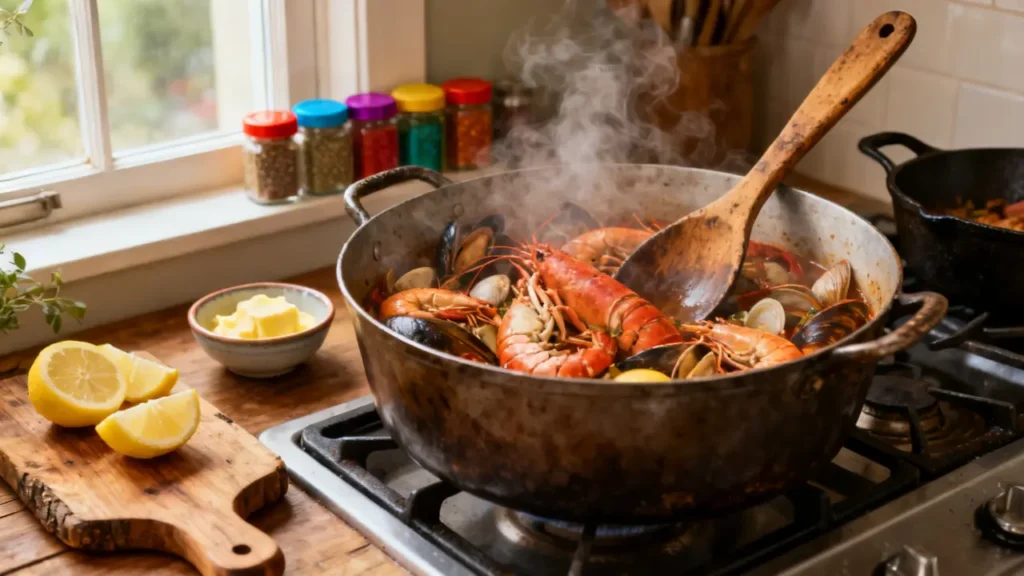

Leftover seafood boil can taste almost-new if you rewarm it the right way. This guide shows how to rewarm seafood boil so shrimp don’t overcook, seasonings stay bright, and leftovers hit the safe temperature with minimal texture loss. Follow the cheat sheet, a tested workflow, and rescue tips for common problems.
How to rewarm seafood boil: quick safety & storage
Refrigerate your seafood boil within 2 hours of cooking (or 1 hour if it sat out above 90°F / 32°C). Leftovers are best within 3–4 days in the fridge; freeze for best quality up to 3 months. When reheating leftovers, follow USDA guidance and bring food to an internal temperature of 165°F (74°C) to be safe.
Why that matters: bacteria grow if food sits too long, and shellfish can be particularly risky if stored incorrectly. Hitting 165°F protects you even though freshly cooked seafood is often served at lower internal temps — the higher reheat temp compensates for storage and uneven warming. Use a probe thermometer and reheat gently to avoid overcooking.
Reheat strategy: separate, stage, and use the right method
The core rule is to warm dense items first and delicate seafood last: reheat potatoes, corn, and sausage fully, then add shrimp, mussels, clams, and crab for the final minutes. This prevents shrimp from becoming rubbery and shellfish from drying out while ensuring everything is safe. When possible, reheat components separately; when you must reheat together, stage the timing so delicate items only need short exposure to heat.
Why it works: potatoes and corn need more time to reach temperature, while shrimp needs a fast burst of heat because its proteins tighten and squeeze out moisture if held at high heat. We recommend adding a splash of liquid or a knob of butter (1/4–1/2 cup / 60–120 ml per 2 lbs of mixed boil) to preserve moisture and flavor during reheating.
- Cheat sheet: times by method below and a full workflow after this section.
Best methods: when to use oven, stovetop, steam, microwave, or grill
Choose the method based on quantity and components: use the oven or foil packets for large trays and potatoes, a covered skillet for mixed pans, and steam for shellfish and crab legs. The microwave is only for small portions; the grill or air fryer works for corn or potatoes but not for delicate shrimp. Use gentle heat and moisture whenever possible to keep texture intact.
Oven (best for large batches, potatoes, corn, crab legs)
The oven is the best choice for reheating a big tray: preheat to 300–350°F (150–175°C), place the boil in a shallow pan, add 1–2 tbsp liquid per pound (stock, beer, or water plus butter), cover tightly with foil, and heat until warm. At 300°F expect 10–15 minutes for 2–3 lb of leftovers; at 350°F aim for 8–12 minutes. Finish by uncovering and adding shrimp or mussels for the last 2–4 minutes.
Stovetop (best for shrimp, mixed pans, quick refresh)
Use a large skillet or Dutch oven on low–medium heat with a splash of stock or water and 1–2 tbsp butter. Cover and warm denser items first for 5–10 minutes, stirring occasionally, then nestle shrimp on top and cook covered for 30–90 seconds or until just heated through. The covered pan traps steam so you can hit 165°F quickly without pounding the seafood with direct heat.
Steamer or steam basket
Steaming is ideal for clams, mussels, and crab legs: bring water or stock to a simmer and steam shellfish until shells open or crab legs are hot. Typical times are 4–7 minutes for mussels/clams and crab legs, and 30–90 seconds for shrimp if pre-cooked. Discard any mussels or clams that fail to open during reheating.
Microwave (fastest — small portions only)
Use medium power (about 50–70%) and reheat in 30–60 second bursts, stirring and rearranging between bursts. Cover with a microwave-safe lid or damp paper towel to trap steam and prevent drying. This method is convenient for one-person portions, but it’s easy to overcook shrimp and unevenly heat dense items.
Grill and air fryer
The grill is great for adding char to corn or sausage; reheat corn at medium heat for 4–6 minutes. The air fryer works for potato chunks or sausages at 350°F (175°C) for 6–10 minutes. Avoid air-frying shrimp or delicate shellfish unless you want them extra firm.
Reheating times & temperatures by component
Different components need different handling: dense vegetables and sausages need steady heat; shellfish needs just a short burst. Below are reliable times and temperatures you can use as a quick reference when deciding how to rewarm seafood boil portions.
Shrimp: Steam or skillet for 30–90 seconds until just hot; avoid more than 2 minutes. Crab legs: Oven at 350°F (175°C) wrapped with 2–4 tbsp water/butter for 7–10 minutes refrigerated, frozen 15–20 minutes. Clams & mussels: Steam until shells open, ~5–7 minutes. Potatoes & corn: Oven 350°F for 12–20 minutes, skillet 8–12 minutes. Sausage: Skillet 6–8 minutes or oven 10–12 minutes.
- Quick cheat sheet: Shrimp 30–90s, Crab legs 7–10m (350°F), Mussels/clams 5–7m steam, Potatoes/corn 8–20m depending on method, Sausage 6–12m.
Step-by-step: reheat a 3–4 lb mixed seafood boil for 4 people
Here’s the tested workflow we use at home for a refrigerated 3–4 lb mixed boil: reheat dense items in the oven or skillet, warm your sauce separately, then finish shellfish quickly so everything stays moist. This staged approach hits safety targets while protecting texture.
1) Preheat oven to 350°F (175°C). 2) Spread potatoes, corn, and sausage in a shallow pan; add 1/4–1/2 cup (60–120 ml) of stock or water and cover tightly with foil; heat 12–15 minutes until steaming hot. 3) Meanwhile, warm your butter sauce in a small saucepan over low heat. 4) Add crab legs and mussels to the pan, cover and heat 4–6 minutes. 5) Place shrimp on top and warm 30–90 seconds before serving; check with thermometer for 165°F.
We tested this exact workflow and found the shrimp stayed tender when added last; Daniel insists on the final thermometer check and Sarah always stirs the sauce into the pan right before serving. If you want a one-pan oven option, see our guide on reheating a seafood boil in the oven for foil-packet specifics.
Reheating from frozen: thaw first when possible
If frozen, thaw overnight in the refrigerator for best texture; then follow the refrigerated workflow. If you must reheat from frozen, use the oven at 350°F (175°C) and expect roughly 50–70% longer times — e.g., crab legs 15–20 minutes, whole mixed trays 25–35 minutes — and add extra liquid before covering. Always verify the internal temp reaches 165°F.
Thawing first improves even heating and flavor retention because cold pockets cause overcooking of outer layers while inner parts lag. For more on warming packaged or bagged boils, try our post on warming a seafood boil bag and options for oven vs. bag methods.
Troubleshooting: rescue ideas for rubbery or bland leftovers
Rubbery shrimp: skip reheating whole — chop and use in shrimp salad, tacos, or chowder where brief heat won’t matter. Overcooked crab: pick meat and make crab cakes or dip. Soggy corn: pat dry and pan-sear or grill for a few minutes to add texture and char. Bland sauce: finish with fresh lemon, chopped herbs, or our quick garlic-butter—see garlic butter sauce.
Common mistake we see: reheating everything at once. I learned the hard way that putting shrimp in with cold potatoes turns shrimp rubbery before the potatoes even warm. Staging saves texture and makes cleanup easier.
Flavor refreshers & serving ideas
Brighten reheated seafood with a squeeze of fresh lemon, a spoonful of compound butter, or a drizzle of hot sauce. A simple compound butter (mix softened butter with garlic, lemon zest, and parsley) melted over the finished boil revives fats and seasoning. Serve with crusty bread to sop up juices or with quick sides like coleslaw and boiled potatoes warmed separately.
For internal links with extra tips, check our Seafood Boil Recipe for seasoning ideas and our walkthrough on reheating leftovers for alternate strategies and bag methods.
Bottom line: best method by situation
Small portion and fast: skillet or microwave bursts with a splash of stock. Large batch: oven at 300–350°F (150–175°C) in foil with liquid. Frozen: thaw overnight when possible, otherwise oven from frozen and add time. Always aim for 165°F (74°C) and keep delicate seafood to the final 2 minutes.


