
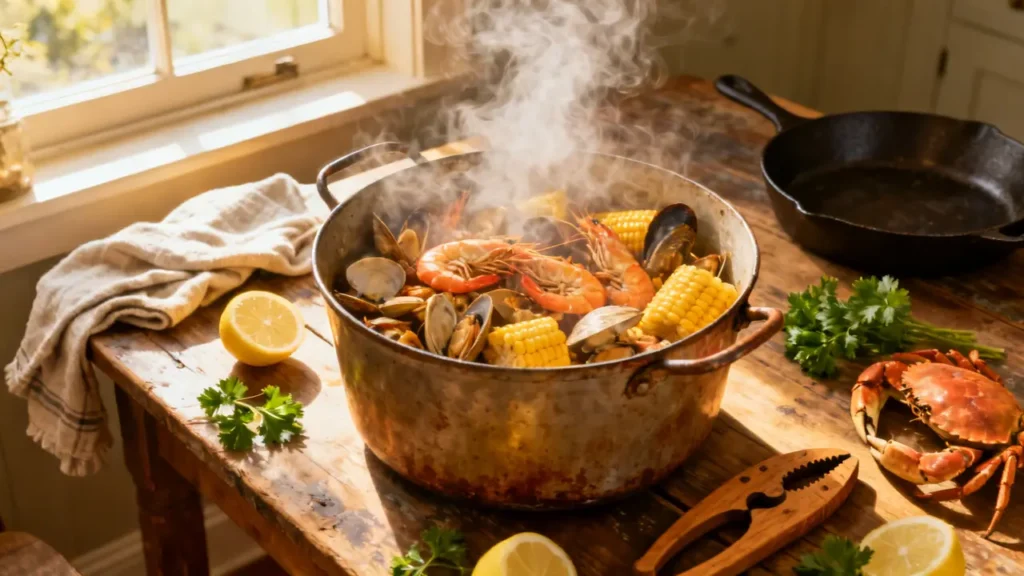

How to warm up seafood boil
The best way to reheat a seafood boil is to stovetop steam it in a large pot with 1–2 cups of leftover boil liquid or seafood stock, adding dense items first and shrimp/crab last so everything hits a safe internal temp without overcooking. This method restores moisture and flavor quickly and gives you control with an instant-read thermometer.
Stovetop steaming keeps delicate proteins from shrinking into rubbery bits because the food heats gently in steam, not direct high heat. If you need to reheat a large batch for a party, the oven or a covered hotel pan works well (covered at 350°F / 175°C). We cover the microwave, Instant Pot, air fryer and troubleshooting below.
Safety first — storage, spoilage signs, and target temperature
Food safety matters: refrigerate seafood boil within 2 hours (or 1 hour if ambient is >90°F) and plan to eat leftovers within 3–4 days. When reheating, always aim for an internal temperature of 165°F / 74°C measured with an instant-read thermometer in the thickest piece.
Why 165°F? That temperature reliably inactivates most foodborne bacteria and is the FDA’s clear guideline for reheated cooked foods. Use the thermometer to spot-check several pieces (potatoes, sausage, and a shrimp or crab joint) because mixed boils can have cold pockets.
How long can you keep a seafood boil in the fridge / freezer?
- Fridge: 3–4 days for cooked seafood boil leftovers.
- Freezer: best quality 2–3 months; texture will degrade over time.
- Do not refreeze thawed seafood that has been fully thawed and left at room temperature for extended time.
How to tell if seafood boil has gone bad
Trust your senses: sour or off odors, slimy texture, or a gray-green color are signs to discard. If shrimp or shellfish smell strongly fishy or metallic, don’t risk it. When in doubt, throw it out — reheating won’t remove toxins or spoilage.
Reheat temperature — why 165°F matters and how to check
Reheat until the coldest part of the food reaches 165°F / 74°C. Insert an instant-read thermometer into the thickest sausage, a potato, and the meatiest part of a crab leg or shrimp. If smaller pieces read quickly, check multiple items to avoid cold spots.
Choose the best reheating method — pros, cons, and when to use each
Pick the method based on batch size and the seafood mix: stovetop steam for mixed leftovers, oven for large batches, Instant Pot/steamer for shellfish, and the microwave only for small portions when speed matters. Each method trades off texture control and time.
Below we give step-by-step times and what to expect for each method so you can choose by ingredients and volume. For storage tips see our internal guide on storing seafood boil leftovers.
Stovetop steam/simmer — best for mixed boils (recommended)
This is our go-to: bring 1–2 quarts of leftover boil liquid, seafood stock, or water with a splash of beer to a simmer in a pot large enough to hold everything in a single or double layer. Add a tablespoon of butter for richness and a squeeze of lemon for brightness.
Order matters: add potatoes/sausage/corn first, simmer 3–5 minutes, then add crab legs and mussels, and lastly shrimp for 1–3 minutes—steam just until everything reaches 165°F / 74°C.
- Pour 1–2 cups of liquid into a large pot per 3–4 pounds of boil and bring to a gentle simmer.
- Add dense items (potatoes, sausage, corn) and simmer 3–5 minutes.
- Add crab legs/mussels, simmer 3–5 minutes; add shrimp last for 1–3 minutes.
- Spot-check with a thermometer; finish with garlic-herb butter.
Oven (covered sheet pan/foil) — best for large batches/potluck
For big batches use a shallow hotel pan or rimmed baking sheet covered tightly with foil at 350°F / 175°C. Layer the boil in one layer, pour 1/2–1 cup of refresh broth per pan, cover, and heat for 10–20 minutes depending on volume — aim for 165°F.
This method is slower but consistent and lets you keep the spread warm on low after reheating. For party service, transfer to warming pans and basins to maintain temperature without drying.
Steamer basket / Instant Pot (steam) — best for shellfish and crab legs
Use a steamer basket or the Instant Pot’s steam function to reheat crab legs and clams quickly: steam or pressure-steam on high for 3–7 minutes depending on size. Avoid long high-pressure cycles — short bursts of steam protect texture.
Microwave — fastest but least recommended
Microwave only small portions. Use medium power (50–70%) in 30–60 second bursts, cover with a damp paper towel or vented lid, and stir or rearrange halfway. Check that the center reaches 165°F / 74°C to be safe.
Air fryer / pan-sear — for crispness and small batches
Air fryers can re-crisp shrimp or give corn a little bite: 350°F for 3–6 minutes for shrimp, flipping once. Be careful: air frying dries items quickly — toss with butter or oil first and check often.
Reheating by ingredient — exact steps, times, and temperatures
Different ingredients need different treatments—starch and sausage handle longer, delicate shrimp do not. Stagger reheating: dense items first, shellfish last, and use thermometer checks rather than guessing.
Potatoes and sausage
Potatoes and smoked sausage take the longest. Reheat them in simmering broth for 5–10 minutes or in the oven at 350°F / 175°C for 15–20 minutes until heated through; they should read hot in the center.
Corn on the cob
Steam corn 4–7 minutes, or wrap in foil with a tablespoon of butter and bake at 350°F for 10–15 minutes. Microwave one ear for 2–4 minutes covered, rotating halfway.
Shrimp (peeled or unpeeled)
Shrimp reheat fastest—steam in simmering broth for 1–3 minutes. Overcooking shrinks and toughens shrimp; remove as soon as the internal temp is 165°F and the flesh is opaque and firm but not rubbery.
Crab legs and claws
Steam crab legs 5–7 minutes, or bake covered at 350°F for 10–12 minutes. For very large legs, split them to let heat reach the center faster. If the meat is cold inside, split and re-steam briefly.
Mussels, clams, oysters (in shell)
Steam mollusks 3–5 minutes until shells open; discard any that remain closed. These are fragile: quick, direct steaming preserves tenderness and flavor.
Mixed reheating order & timeline
For a typical mixed boil (potatoes, corn, sausage, crab, shrimp): bring broth to simmer, add potatoes/sausage/corn (3–5 min), then crab/mussels (3–5 min), and finally shrimp (1–3 min). Total time is commonly 5–10 minutes on the stovetop.
Reheating from frozen — step-by-step
Thaw frozen seafood boil overnight in the fridge when possible. For quicker thawing, seal in a plastic bag and submerge in cold water for 30–90 minutes, then reheat using the refrigerated methods; never reheat from frozen in the microwave as a first choice—thaw first to avoid uneven heating.
If you must reheat from frozen, use the oven covered at 350°F for longer (20–30 minutes) and check internal temps at multiple spots to ensure 165°F.
Flavor refreshers & finishing touches
Refreshing flavor is as important as safety. A quick refresh broth—leftover boil liquid, seafood stock, or even beer with a touch of butter and lemon—brings the seasoning back. Finish with a hot garlic-herb butter and a sprinkle of parsley or Old Bay for bright flavor.
Quick Refresh Broth (ready in 3 minutes): 1 cup seafood stock or leftover boil liquid, 1 tbsp butter, juice of half lemon, pinch salt. Heat to a simmer and pour over reheated boil before serving.
Troubleshooting — common problems and fixes
If shrimp are rubbery, serve them immediately with a warm garlic-butter sauce to mask texture and avoid further heating. If crab meat is cold in the center, split the shell and steam for 2–4 minutes until hot.
Common mistakes: reheating everything at once (stagger instead), not adding liquid, or using too-high oven temperatures. We mention in our garlic-butter guide how a quick sauce can rescue dry bites.
If shrimp is rubbery — quick rescue and prevention
Rescue: toss rubbery shrimp lightly in melted butter with lemon and serve as a dipping item. Prevention: remove shrimp from heat as soon as they turn opaque and read 165°F.
If crab meat is cold inside — split legs, steam briefly
Split or crack legs, steam 3–5 minutes and check the center with a thermometer. This speeds heat penetration and prevents overcooking the outer meat.
Best method for serving at parties / large batches
For potlucks, use hotel pans covered with foil and heat at 350°F until everything reaches 165°F, then transfer to chafing dishes or warming trays. Keep steam trapped with lids or foil to prevent drying and have extra refresh broth on hand to ladle over the pan.
If you need stepwise party prep, reheat dense items earlier and add delicate shellfish last on site. For logistics and storage tips see our internal piece on making and reheating seafood boils in the oven.
Bottom line — recommended method for most home cooks
When someone asks how to warm up seafood boil, our recommendation is simple: stovetop steam with 1–2 cups of refresh broth, add dense items first, shrimp last, and heat to 165°F / 74°C. This preserves texture and restores flavor with the least risk of overcooking.
For large batches use a covered pan at 350°F, and for shellfish-heavy trays, use a steamer or Instant Pot steam cycle. Keep butter and lemon handy for finishing — they rescue moisture and taste.


