
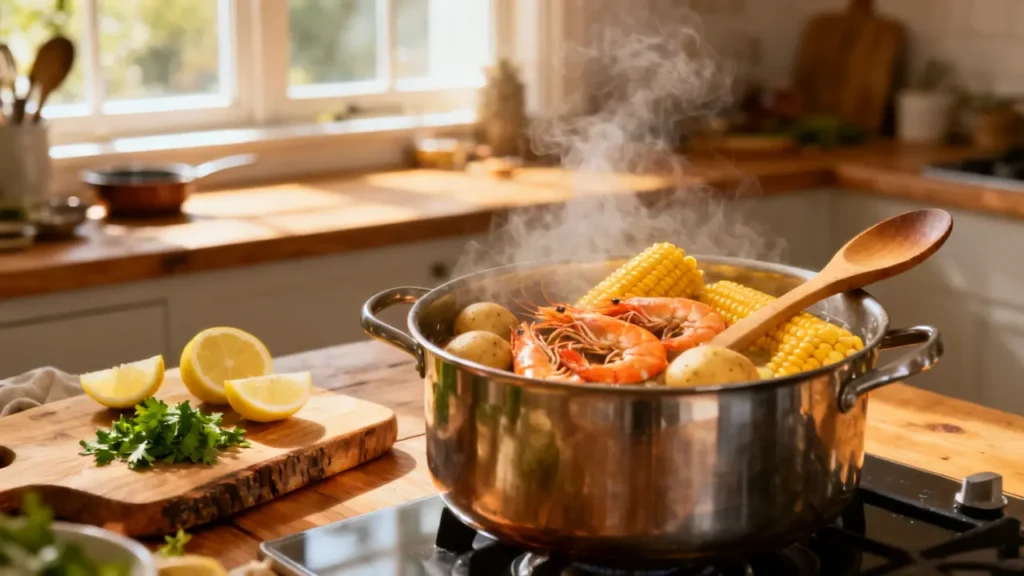

Quick answer — best way to reheat a leftover seafood boil
The best way to reheat leftover seafood boil is a gentle, moist method like stovetop steaming or using a steamer basket — they revive flavors without tightening shellfish proteins. For the highest-quality texture choose sous‑vide (130–140°F / 54–60°C) if you have the gear, and use the oven for large pans. Always reheat until an instant-read thermometer shows 165°F (74°C) for safety unless you use validated sous‑vide time/temperature pasteurization tables.
Moist, covered heat stops shellfish from going rubbery and keeps corn and potatoes from drying out. For quick single portions the microwave is fine if you use short bursts, a splash of liquid, and a cover. If your seafood came in a sealed boil bag, see our note on safely warming the bag below or check our page on reheating a seafood boil bag.
Food safety: storage, thawing, and thermometer rules
Store leftovers in the fridge within 2 hours of cooking and use within 3–4 days; freeze for best quality up to 2–3 months. Thaw frozen seafood overnight in the refrigerator or use a cold-water quick-thaw (sealed bag, change water every 30 minutes). Never refreeze previously thawed seafood unless it was cooked again.
USDA guidance: reheat leftovers to an internal temperature of 165°F (74°C) — use an instant-read thermometer and probe into the thickest piece (potato center, thick sausage, or inside crab legs). Chefs sometimes prefer lower temps for texture with sous‑vide; if you choose a lower finish temperature, follow validated sous‑vide hold times for safety or finish briefly to reach 165°F for the safest route.
- How to warm up a seafood boil — storage and simple reheats
- Garlic butter for seafood — finishing sauce
- Reheat in the oven — large batch method
- Reheat a seafood boil bag — bag-specific tips
Best reheating methods — when to use each
Pick a method by portion size and priority: stovetop steaming for mixed leftovers, oven for large trays, sous‑vide for texture, microwave for speed, and air fryer only for firm items like corn or sausage. Avoid dry, high heat on delicate shellfish — they tighten and get rubbery. Use moist, covered heat to gently bring everything through.
For crowd reheats use hotel pans or the oven in shifts; for single servings steam or microwave. If you have a sealed boil bag, warming it in simmering water works well — see our bag-specific section and our oven page for tray reheats.
Step-by-step methods
Stovetop steaming (best overall for mixed boils)
Set a large pot with a fitted insert or colander above 1–2 cups of liquid (beer, seafood broth, or water plus a splash of lemon) and bring to a low simmer. Layer the cold seafood boil in the insert, cover tightly, and steam gently for 5–10 minutes for refrigerated portions — check that the thickest pieces reach 165°F (74°C).
Start with potatoes and sausage on the bottom and flaky shellfish or shrimp on top so heat-sensitive items get gentler steam. For uneven pieces, stream for 3–5 minutes, open the lid, rearrange, then finish; this avoids overcooking exposed shrimp while warming thick crab legs.
Steamer basket (gentle, preserves texture)
Bring 1–2 inches of water to simmer in a wide pot, place a steamer basket, and stagger items by cook-sensitivity (potatoes/sausage bottom, corn mid, shellfish top). Cover and steam: mixed tray 5–8 minutes, shrimp ~2–4 minutes, mussels/clams 3–6 minutes until shells open.
Check at intervals and use an instant-read thermometer in the thickest item. If porky-smelling or any bivalves remain tightly closed after steaming, discard them — don’t pry them open.
Oven (best for large batches)
Preheat oven to 275–300°F (135–150°C) for gentle reheating or 350°F (175°C) for a faster finish. Spread the boil in a covered pan or wrap tightly in foil with a splash of broth/beer (about 1/2–1 cup per 4–6 lb pan) and warm for 12–18 minutes at 275–300°F or 8–12 minutes at 350°F; finish uncovered 2–3 minutes to refresh.
Oven is ideal for parties because you can hold at warm temperatures, but avoid long holding that dries shellfish. If crab or lobster look dry, drizzle garlic-butter before serving.
Sous‑vide (best texture)
Vacuum-seal portions and set the bath to 130–140°F (54–60°C) for a quality-focused reheat, holding for 20–30 minutes to warm through. This keeps shrimp and lobster tender but is a chef-quality approach — it does not meet USDA’s quick reheat 165°F rule unless you follow validated time/temperature pasteurization tables.
If safety is your priority, finish briefly to 165°F (74°C) or use sous‑vide pasteurization timings. Vacuum-bag with a splash of broth or garlic-butter to add flavor and moisture.
Microwave (fastest for single portions)
Place seafood in a microwave-safe bowl, add a splash of broth or water (~1–2 tbsp per cup), cover with a microwave-safe lid or damp paper towel, and heat on medium/high in bursts of 30–60 seconds, stirring or turning between bursts. Total time for a plate: 1–3 minutes depending on amount; check temperature to reach 165°F.
Microwave is convenient but uneven; avoid for large batches or delicate whole lobster as hotspots can overcook outer meat while center stays cool. Use only when speed matters.
Air fryer (for corn and sausage)
Use the air fryer to refresh corn or crisp sausage: 350°F (175°C) for 4–8 minutes for corn and 4–6 minutes for sausages. Do not use the air fryer for shrimp, mussels, or lobster — they’ll quickly dry and toughen.
Cheat sheet — component times & temperatures
Short reference for common items: steam mixed portions 5–10 minutes, oven covered 275–350°F for 8–18 minutes, microwave in bursts for single plates. Always confirm thick pieces read 165°F (74°C) with an instant-read thermometer.
- Shrimp (cooked, refrigerated): steam 2–4 min, microwave 1–2 min.
- Crab/lobster legs: steam/oven 6–10 min.
- Mussels/clams: steam 3–6 min until shells open; discard unopened shells.
- Potatoes (small): oven 10–15 min at 350°F or microwave 2–4 min.
- Corn on the cob: steam 6–10 min, air fryer 4–8 min at 350°F.
- Sausage: stovetop or air fryer 4–8 min.
How to reheat specific items
Shrimp
Shrimp overcook fast because their proteins tighten; warm them briefly to just-hot. Steam for 2–4 minutes or microwave in 30–45 second bursts with a splash of liquid. Stop the moment they’re warmed through to avoid rubberiness.
Crab legs & lobster
Steam or oven-warm crab and lobster legs for 6–10 minutes depending on size; keep covered with a little broth or butter to prevent drying. If you’ve got meat out of the shell, finish in butter for one to two minutes to refresh flavor.
Mussels & clams
Reheat by steaming until shells open — usually 3–6 minutes. Discard any that remain tightly closed after reheating; they may be unsafe. Keep them covered with a lid and a splash of broth to keep briny juices intact.
Corn, potatoes, sausage
Reheat hearty items longer and separately if needed: corn 6–10 minutes steam or 4–8 minutes air fryer; potatoes 10–15 minutes at 350°F for oven trays or 2–4 minutes microwave; sausage 4–8 minutes stovetop or air fryer. Reheating these separately prevents overcooking delicate seafood.
Reheating for a crowd — batch tips
For parties, reheat in hotel pans or multiple smaller trays rather than one deep pile — shallower layers warm more evenly. Use the oven at 300°F (150°C) covered for large pans (allow 12–18 minutes), and hold at low heat only briefly; quality drops quickly if seafood sits too long.
Staging: warm potatoes and sausage first, then add shellfish late so they only need a short finish. For bagged boils, recess them in a pot of simmering water (in the sealed bag) and then open and finish in a covered pan with butter or broth.
Troubleshooting common problems (and fixes)
Rubbery shrimp? Quickly steam with a splash of liquid for 1–2 minutes — short, moist heat relaxes textures. Dry crab or lobster? Drizzle warm garlic-butter or broth and cover for a few minutes to rehydrate. Soggy corn can be refreshed in a hot oven or air fryer for a few minutes to crisp the kernels.
I learned the hard way that piling a pan deep to save time leaves cold centers. I now always spread items in a single layer when possible; smaller batches transfer heat evenly and cut rescue time. Use an instant-read thermometer — it’s the fastest way to spot underheated spots.
Unopened mussel or clam shells after reheating should be discarded — they were likely dead before reheating and can be unsafe. If you smell off or overly fishy odors, toss the batch; safety beats trying to rescue questionable seafood.
Flavor & finishing touches
Finish reheated seafood with a quick sauce: melt 4 tbsp butter with 1 clove minced garlic, 1 tbsp lemon juice, and a pinch of salt for every 4 servings. Toss warmed seafood once in the sauce right before serving to add gloss and moisture. For a party, serve extra garlic-butter in a warmed pitcher for dipping.
Try a sprinkle of chopped parsley and a squeeze of lemon to brighten reheated flavors. If you want a richer finish, fold in a tablespoon of browned butter per 4 servings — it masks slight dryness and smells fantastic.


