
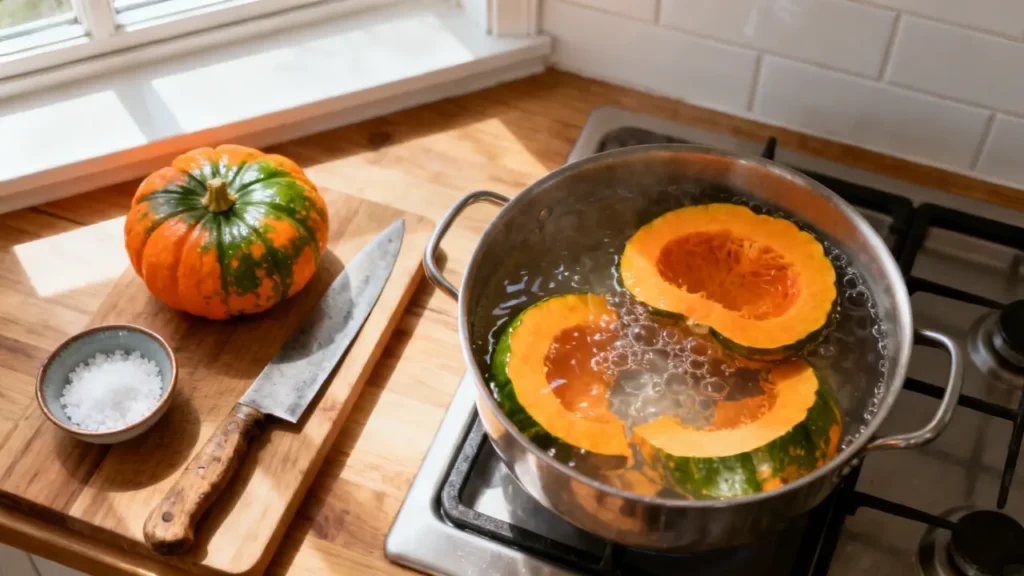

Is boiling the right method for your kabocha?
Boiling is a great choice when you want tender, mild-flavored kabocha fast—ideal for mashes, soups, baby food, or when you need cubes that will hold their shape in a salad or tempura. It’s quicker than roasting and less likely to dry the flesh than steaming if you keep an eye on time. Choose boiling for speed and for recipes where moisture isn’t a fault; pick roasting when you want concentrated, caramelized flavor.
Boiling transfers heat through water so bigger pieces cook from the outside in; that makes method and start temperature important. For small cubes start in already boiling water to minimize breakdown, while large halves or whole fruits do best started in cold water to avoid an overcooked rim. We’ll show exact times and cues below so you don’t guess.
Prep: how to clean, cut, and seed kabocha safely
Start by rinsing the squash and drying it, then stabilize it on the cutting board so the knife won’t slip—cutting a thin slice off the bottom gives a flat base. Use a sharp, heavy chef’s knife to halve or wedge the squash, scoop out seeds with a spoon, and decide whether to leave the skin: kabocha skin is edible and thins when cooked, but remove it if you want a silkier puree.
For even cook times, cut to consistent sizes: 1-inch cubes for salads, 2-inch chunks for mashing or soup, and halves/wedges for scooping. If you prefer a quick visual guide, think about thickness—the thicker the piece, the longer the boil. If you want step-by-step cutting photos, check our guide on boiling other winter squashes like how to boil butternut squash for similar prep techniques.
Tools you’ll need
- Large pot (size to fit the squash pieces comfortably)
- Sharp chef’s knife and sturdy cutting board
- Slotted spoon or tongs
- Colander for draining
- Instant-read thermometer (optional)
How long to boil kabocha squash — quick reference
Here’s the short answer to the question how long to boil kabocha squash: 1-inch cubes: 8–12 minutes; 2-inch cubes: 12–15 minutes; halved/wedges (2–3 lb squash): 15–25 minutes; small whole kabocha (about 2–3 lb): 30–45 minutes. Start timing when the water returns to a boil and use a fork test to check doneness.
Times assume sea level (boiling point 212°F/100°C) and pieces dropped into already-boiling water for cubes; add about 5–10% extra time above ~3,000 ft elevation. Use the lower end of ranges if you want the pieces to hold shape (salad/tempura) and the higher end when you want falling-apart flesh for purees or soups.
- 1-inch cubes: 8–12 minutes — fork-tender but holding shape
- 2-inch cubes: 12–15 minutes — best for mashing or pureeing
- Halves/wedges: 15–25 minutes — scoopable, great for stuffing or mash
- Whole (small, 2–3 lb): 30–45 minutes — pierce to vent and test often
Step-by-step: how to boil kabocha (cubes, wedges, halves, whole)
For cubes and wedges, bring a large pot of salted water to a rolling boil, add the pieces, return to a boil, then start timing; this preserves shape and speeds cooking. For large halves or a whole kabocha, place it in cold water then bring up to a gentle boil to prevent the outside from overcooking while the center warms through.
Use about enough water to cover the pieces by an inch or two; cover the pot to shorten the time but crack the lid for long boils so you don’t have an aggressive boil that knocks pieces apart. Drain in a colander immediately and let steam off for a minute if you want drier flesh for roasting or mashing.
For cubes / wedges
- Bring a large pot of water to a full boil and add 1 tsp salt per quart (optional).
- Add 1-inch or 2-inch pieces and return to a boil, then start timing.
- Cover and simmer so water keeps a steady boil; check at the low end of the time range with a fork.
- Drain and cool slightly or mash/season as directed.
For halves / whole
Place the halved or whole kabocha in cold water, bring the pot to a gentle boil, then simmer; pierce a whole squash once or twice to vent so it doesn’t crack. For a 2–3 lb halved squash expect about 15–25 minutes, and a small whole one about 30–45 minutes—test earlier to avoid soggy edges.
How to test for doneness and target textures
Doneness is best judged with a fork: for salads and stir-fries the fork should slide in with slight resistance; for mashes and purees it should meet almost no resistance and pieces may flake apart. If you prefer numbers, an internal temp over ~95°C (203°F) usually means very soft, falling-apart flesh.
Visual cues matter: just-tender flesh looks matte and holds its shape; overcooked flesh breaks into stringy bits and tastes watery. For halves, scrape a spoon across the surface—if it squishes easily and the flesh separates from the rind, it’s ready to scoop.
Salt, flavoring, and water tips
Salting the boiling water (about 1 teaspoon per quart) seasons the squash and slightly raises the boiling point, helping even heat transfer. Add aromatics like a bay leaf, a strip of kombu, or slices of ginger to infuse gentle flavor, remembering that strong aromatics will change the delicate kabocha taste.
A common trick: for sweet-savory finishes, finish boiled cubes in a hot skillet with a pat of butter or miso glaze so they get a little caramelization without long roasting time. For soups, keep times at the longer end to ensure a silky puree.
Troubleshooting common problems
If your squash turns out waterlogged and bland, drain well and spread the pieces on a rimmed sheet and roast at 425°F (218°C) for 8–12 minutes to dry and concentrate flavor. If it’s undercooked, return to simmering water or finish in a hot oven for 8–10 minutes.
Stubborn skin? If the rind won’t come off, remove it after boiling—the softened skin will pull away easily—or roast instead for easier peeling. A common mistake we see is crowding the pot; crowding drops the temperature and stretches cook times, so work in batches if needed.
Personal kitchen note: I once tried to cook a large kabocha whole in a small pot and the exterior was mushy while the center stayed firm—since then I always halve the squash or start large pieces in cold water and test early. That one mistake taught me to match pot size and start temp to the piece size.
Using boiled kabocha—recipes & serving ideas
Boiled kabocha is versatile: shorter boils (8–12 minutes) give cubes for salads and tempura, mid-range boils make excellent curry or stew pieces, and long boils (12–15+ minutes) are perfect for soups and purees. For a quick mash, drain, mash with butter, a pinch of salt, and a splash of cream; for soup puree with stock and finish at 160–170°F (71–77°C).
Want other winter squash ideas? See how similar cuts behave in our posts on boiling acorn squash and boiling spaghetti squash to compare textures and pick the right final dish.
Storage, freezing & reheating
Cool boiled kabocha quickly, refrigerate in an airtight container for 3–4 days, or freeze in portioned bags for up to 3 months. For freezing, flash-freeze on a tray then transfer to bags so pieces don’t clump; thaw in the fridge or reheat straight from frozen in a saucepan with a splash of water.
To reheat without losing texture, sauté thawed pieces in a hot skillet for 4–6 minutes or roast at 425°F (218°C) for 8–12 minutes to refresh surfaces and concentrate flavor.
Steam vs boil vs roast — quick comparison
Choose boiling for speed and even tenderness, steaming for a slightly firmer, less waterlogged finish, and roasting for the richest, caramelized flavor. Steam times are similar to boiling (about 10–20 minutes depending on cut) but tend to produce less soggy flesh, while roasting takes longer (25–45 minutes) and concentrates sugars.
If you want concentrated flavor for a dinner centerpiece pick roasting; if speed and gentle cooking for baby food or mash matters, boiling or steaming are both great—boiling is slightly faster for small pieces.
Altitude and safety notes
At higher altitudes water boils at lower temperatures, so add about 5–10% extra cooking time above ~3,000 ft and always test with a fork. Never handle a whole hot squash without heat-safe gloves; pierce and let cool slightly before moving a whole fruit from boiling water to avoid steam burns.


