
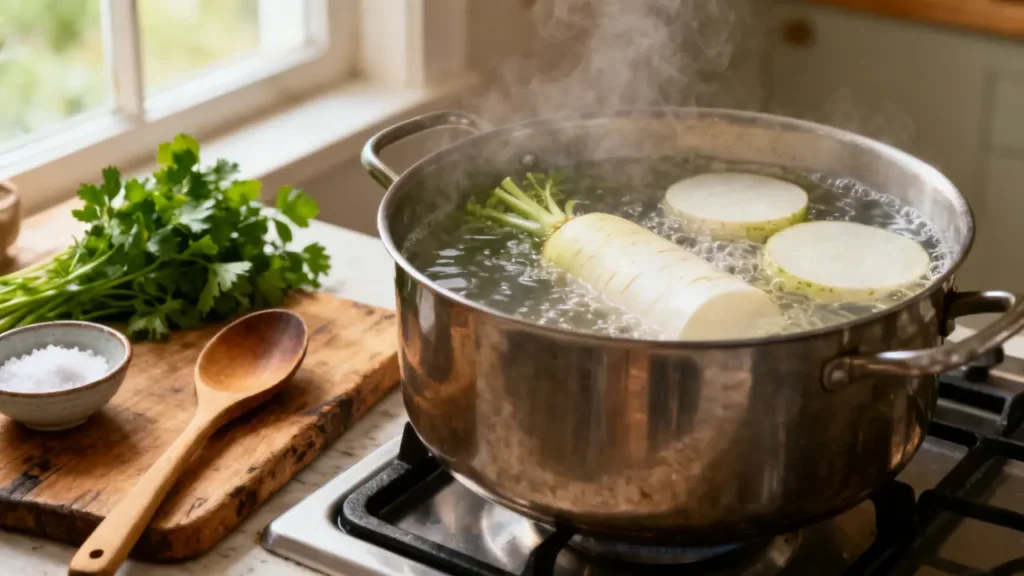

Quickly and reliably: how long to boil daikon so it reaches the texture you want, from crisp-slices to melt-in-your-mouth simmered wedges. We give exact times, cooking methods (stovetop, pressure, steam, microwave), sensory cues, and fixes for common problems. Follow our step-by-step times and pro tips.
How long to boil daikon — quick time chart
The short answer: boil or simmer daikon until fork‑tender, with times that depend on cut size. Typical targets: 1/4″ slices 3–5 minutes, 1/2″ slices 4–6 minutes, 1″ rounds/cubes 10–15 minutes, thick wedges 20–30 minutes, whole small daikon 30–40 minutes, large whole 45–60+ minutes.
These ranges assume a gentle simmer (water at about 185–205°F / 85–96°C) rather than a violent rolling boil—simmering preserves shape and keeps broth clear. For very fast results use a pressure cooker or microwave (times below), but always test with a fork or skewer and adjust for your desired texture: slightly resistant for salads; soft and translucent for oden.
- 1/4″ (6 mm) slices: 3–5 minutes — tender‑crisp, great for salads.
- 1/2″ (12 mm) slices: 4–6 minutes — soft but holding shape.
- 1″ (2.5 cm) rounds/cubes: 10–15 minutes — fork‑tender for soups/stews.
- Thick wedges (1–2″): 20–30 minutes — melt‑in‑the‑mouth for long simmers.
- Whole small daikon (peeled 6–8″): 30–40 minutes; large whole: 45–60+ minutes — test with skewer.
Why daikon cooking time varies
Daikon cooking time varies because of piece thickness, surface area and cell structure: thicker pieces have more cell walls to soften and less surface exposed to hot water. Also, the more intact the piece (whole vs sliced), the longer heat takes to penetrate to the center.
Simmering vs rolling boil matters: simmering at ~185–205°F (85–96°C) breaks down pectin slowly so pieces keep shape; a rolling boil at 212°F / 100°C agitates pieces and can make them split or turn mushy. Salt and acidity (vinegar, soy) change cell wall softening a bit, so add strong acids late in cooking if you want intact pieces.
Prep and simple treatments before boiling
Start with a firm daikon and decide whether to peel: for soups and oden we always peel to get a clear broth and uniform texture; for quick salads or when skin is thin, a scrub is fine. Trim both ends and remove woody or pithy cores from the center of very large roots.
Cut pieces evenly — consistent sizes mean consistent cook time. For fast cooking cut crosswise slices or 1″ rounds; for stews cut into 1–2″ wedges; to keep daikon whole, halve lengthwise so heat penetrates faster. Optional pre‑treatments: a quick 1–3 minute parboil removes a mild bitterness, scoring the surface helps large wedges absorb broth, and a light salt rub (10–15 minutes) draws out water and concentrates flavor.
Best cooking methods (times and step‑by‑step)
Stovetop simmering is the most reliable for flavor and texture: bring water or broth to a boil, add daikon, then reduce to a gentle simmer and cook to the times above. Keep the pot partially covered—this keeps heat even while allowing steam to escape and prevents boiling over.
Step‑by‑step stovetop for 1″ chunks: place daikon in cold water or dashi, bring to a boil, drop to simmer and cook 10–15 minutes, test with fork; for wedges, simmer 20–30 minutes. If you’re making oden or long braise, parboil 1–3 minutes first, then simmer in seasoned dashi for flavor without clouding the broth.
Pressure cooker / Instant Pot
Pressure cooking is great for fast, even tenderness but it’s easy to overshoot. Use high pressure times: slices 2–4 minutes (quick release), 1″ chunks 5–7 minutes (quick release), large wedges 8–12 minutes (natural release recommended). Reduce time if you want a firmer bite and always check before serving.
For pressure cooker basics and conversions see our instant‑pot guide — it helps with timing other vegetables too: pressure‑cooker daikon guide. If you need general pressure‑cook potato conversions, our potato pressure‑cook guide is handy for comparison.
Steaming and microwave
Steaming is gentle and keeps daikon from sitting in diluted broth; expect 6–10 minutes for 1/2″ slices and 15–25 minutes for wedges depending on basket heat. Microwave single portions (600–800W) in a covered microwave‑safe bowl: 1/2″ slices 2–4 minutes, then check and continue in 30–60 second bursts.
Combination method for oden / simmered dishes
For translucent, flavorful oden daikon we recommend parboiling 2–3 minutes to remove cloudiness and mild bitterness, then simmering in dashi over low heat for 30–60 minutes until translucent and soft. Add soy salt and mirin late so the daikon soaks the dashi flavor without toughening the center.
How to tell when daikon is done (sensory cues)
Doneness is about texture and translucence, not just time. For tender daikon you want a fork or skewer to slide in with little resistance and the flesh to look slightly translucent; for firm daikon used in salads, expect a faint resistance and opaque white flesh.
Visual cues: slices soften and lose their raw matte white; large pieces go from opaque to partially translucent at the edges. Taste one: firm but cooked should give a slight chew; melting daikon will feel silky and break apart on the fork.
Troubleshooting common problems
Bitterness, mushiness, splitting and cloudy broth are common but fixable. Bitterness often comes from old or very large roots—parboil 1–3 minutes and discard that water, or peel deeper into the white flesh; overcooking happens when heat is too high or time is excessive.
Splitting and mush: avoid a rolling boil and keep to a gentle simmer at 185–205°F (85–96°C). Cloudy broth is usually caused by vigorous boiling or not rinsing starchy scraps; starting daikon in cold water and bringing it up slowly helps keep stock clear.
- Bitterness: parboil 1–3 minutes or score and salt briefly to draw it out.
- Mushy daikon: lower heat, shorten time, or cut larger pieces next time.
- Cloudy broth: simmer gently and skim once near start.
Personal note: I once simmered a whole daikon for oden at too high a heat and ended up with a mushy, flavorless center. After that I always parboil briefly, use a low simmer, and test the center with a skewer at the halfway mark—those small checks save a whole pot.
Recipe‑specific timing and tips
For oden and long simmers aim for soft, translucent daikon: parboil then simmer in dashi for 30–60 minutes until translucent and flavorful. Add soy, mirin or miso late so the seasoning penetrates without tightening the flesh.
For soups (miso, tonjiru) use 1″ chunks 10–15 minutes so the daikon holds shape and contributes sweet broth. For quick pickles or salads, blanch or parboil 1–3 minutes then shock in ice water to keep crunch and brighten color.
If you’re short on time, the pressure cooker speeds things up—see our instant pot link above for method specifics and remember to use quick release for thin pieces to avoid overcooking.
Storage, reheating, and pro tips
Cooked daikon keeps in the fridge for 3–4 days in an airtight container; store in its cooking liquid if possible to maintain texture and flavor. Reheat gently over low heat or in the microwave in short bursts—avoid boiling again as that softens texture further.
Pro tips: scoring large wedges before simmering helps flavor penetrate; add a splash of acid or a pinch of sugar to brighten long‑simmered daikon; and when you want clear broth start daikon in cold water and bring it up slowly. For similar root cooking techniques, check our pieces on lotus root and kabocha: lotus root tips and kabocha timing.
Quick reference and conversion reminders
When in doubt, aim for the middle of the recommended ranges and test visually and by taste. Boiling point at sea level is 212°F / 100°C, simmer is 185–205°F / 85–96°C; at high altitude water boils at lower temps so expect slightly longer cook times.
And if you want faster, hands‑off timing for big batches, our pressure‑cooker notes and general pressure conversions are a helpful cross‑reference: see how to boil in an Instant Pot and our pressure potato guide pressure‑cook potatoes.


